![[Freelance]](../gif/fl3H.png)
International solidarity with Assange
MEMBERS OF London Freelance Branch and other NUJ Branches joined a human chain around the Palace of Westminster to oppose the extradition of Julian Assange.
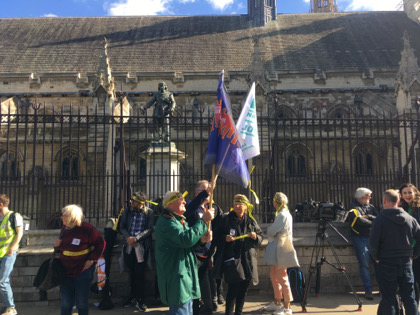
Dominique Pradalié, President of the IFJ (centre, in dark jacket,) attends the 8 October Assange solidarity demo. LFB's Tim Dawson (face partly obscured by banners) and Jenny Vaughan (left, in red jumper) are also in attendance.
The 8 October human-chain demonstration surrounded the complex that includes the Houses of Parliament and extended across Westminster Bridge. The organisers expected that they would need around 5000 people to achieve this. This being the day of a train strike, many attendees had very early starts to come by coach or drive to London. Despite this, it was not long before the klaxons on the stewards' megaphones sounded, signalling that we had comfortably surrounded the Palace of Westminster. Organisers estimated that some 7000 were in attendance.
Overseas journalists covering the event appeared to outnumber reporters from mainstream UK news outlets. Among the banners was one from a Regio Emilia Julian Assange solidarity group - from Northern Italy.
In the NUJ bloc near the statue of Oliver Cromwell, members of LFB and other NUJ Branches were joined by a small delegation that had travelled all the way from Paris. This included Dominique Pradalié, President of the International Federation of Journalists (IFJ), of which the NUJ is a part. Pradalié is a former General Secretary of France's Syndicat National des Journalistes, that country's biggest journalists' union. She said: "The offences for which the United States is pursuing Assange are acts that every journalist performs ever day... If Assange goes to jail, there is not a journalist on earth who will be safe."
Others spotted at the Assange solidarity demonstration included Assange's wife Stella, comedian Russell Brand, former Labour leader Jeremy Corbyn, retired Len McCluskey, former General Secretary of Unite the Union, and former Shadow Chancellor John McDonnell.
Previous Home Secretary Priti Patel confirmed the decision to extradite Julian to the US, after he lost a challenge to the UK Supreme Court. In the US he faces trial on multiple charges under the Espionage Act, relating to his disclosures via WikiLeaks including the "Pentagon War Logs" revealing war crimes in Afghanistan and Iraq.
Assange's legal team has made an application to appeal against his extradition in the High Court. This Court will only consider appeals if there are "significant legal issues" in question. We await a decision on whether this appeal will be allowed. Other avenues for appeal1 are still open.
For background on Julian's case and its implications for journalism, see here and see also the websites of the NUJ and the IFJ.