![[Freelance]](../gif/fl3H.png)
Lords demand respect for copyright
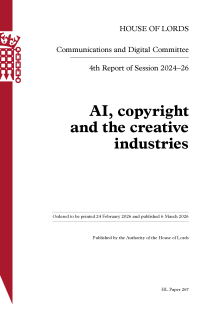
THE UK HOUSE of Lords Communications and Digital Select Committee issued its report on AI, copyright and the creative industries on Friday 6 March. That it is positive for authors and performers is clear from the opening sentences:
“The UK faces a choice between two futures. In the first, the UK becomes a world-leading home for responsible, licensing-based artificial intelligence (AI) development, where commercial model developers using UK content obtain permission, pay fair remuneration to rightsholders and can deploy their models without questions of legal liability...
“In the second scenario, the UK continues to drift towards tacit acceptance of large-scale, unlicensed use of creative content and long-term dependence on opaque models trained overseas, with most benefits accruing to a small number of US-based firms while harms to UK creators grow.”
The Committee's recommendations to the UK government are:
- Rule out a new commercial text and data mining exception with an opt-out model;
- Close gaps in protection for identity, style and digital replicas;
- Make transparency about AI training data a statutory obligation;
- Create the conditions for a fair and inclusive UK licensing market;
- Champion the development of technical standards for control, provenance and labelling; and
- Prioritise the development and adoption of sovereign AI models.
We are now left wondering what more we should have asked for.
The first point is critical and directly rebuts the government's preferred option in its consultation on “AI” and copyright. Their Lordships recognise that demanding that authors and performers specify which words we do not allow to be ingested is “not a viable foundation... The tools currently available for rights reservation are fragmented, poorly understood and place an unreasonable burden on individual creators.”
Indeed, given AI companies' practice to date of stealing everything, could creators trust them to respect an opt-out even if there were a viable means to declare it? As the Committee puts it, opt-outs “rely on crawlers identifying themselves and complying with the rules they encounter. Studies suggest that while the majority of the AI crawlers operated by large companies do respect robots.txt, some ignore these signals or even attempt to circumvent website preferences using ‘stealth’ user agents.”
The second proposal - of new law on “identity, style and digital replicas” - will require some care. At its starkest: no law should allow suppression of a photo of a politician emerging from a crack den at 3am on the grounds of a right in their identity or image. This can be addressed with carefully-crafted “exceptions” to any new right; it will also make the issue of preventing SLAPP lawsuits more urgent.
We are still reading the detail. Please refresh this page to check for updates.
Meanwhile in joined-up Europe...
We expect the European Parliament to adopt on Monday 9 March a report on “copyright and generative artificial intelligence”. The draft, which is here, “reiterates that rights holders, especially from the press and news media sector, and especially press publishers, journalists and news editors, must have full control over the digital use of their content by AI systems and models for training purposes”. It calls for transparency, compensation for unlawful use to date, the labelling of AI-generated works and a form or right of identity.
 AI, copyright and the creative industries parliament.uk
For the future of humanity Isabelle Diran at our February meeting
'Artificial Intelligence' our coverage to date
AI, copyright and the creative industries parliament.uk
For the future of humanity Isabelle Diran at our February meeting
'Artificial Intelligence' our coverage to date