![[Freelance]](../gif/fl3H.png)
For the future of humanity
ISABELLE DORAN, co-vice-chair of the Creator’s Rights Alliance (CRA), told the February meeting about its work. She is CEO of the Association of Photographers (AoP)and the CRA is the body that brings together the National Union of Journalists, Equity, the Association of Photographers, the Society of Authors and other organisations that represent “those of us who make our living from copyrighted works”.
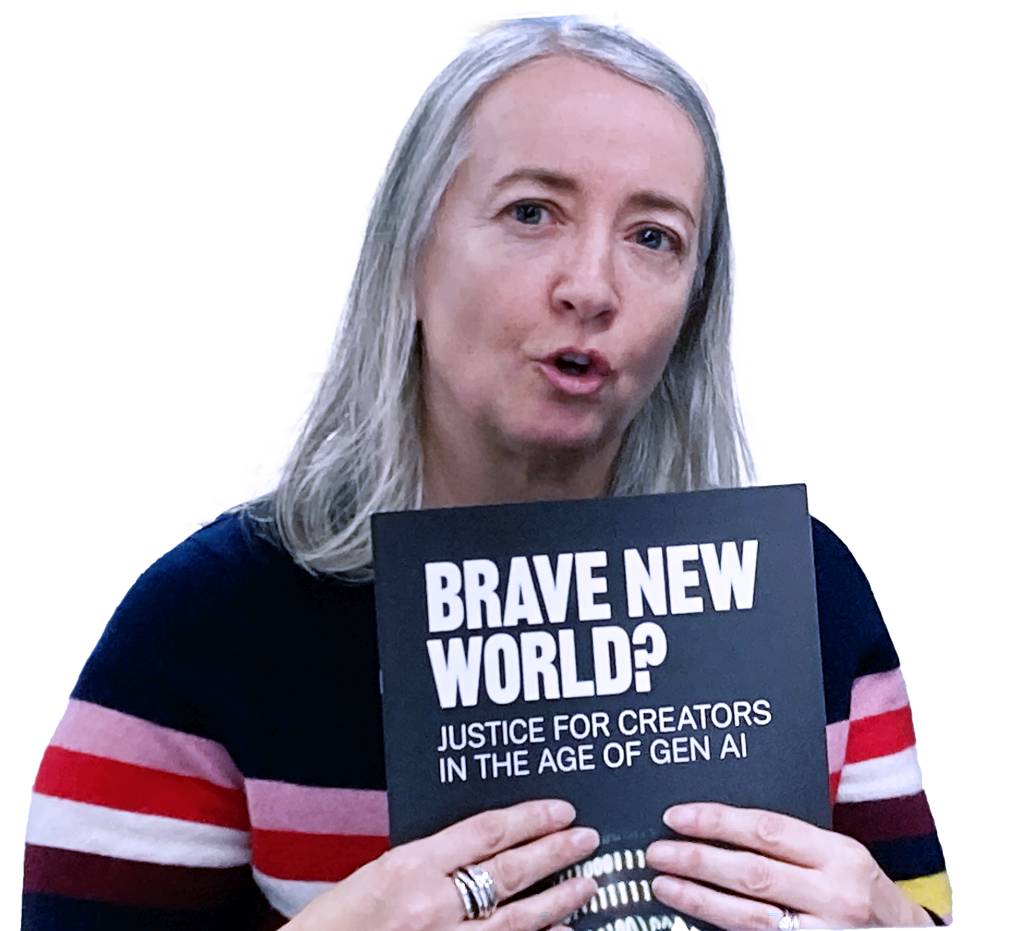
Isabelle Doran with the Brave New World? report
We started the year with the government having launched a consultation on copyright and “artificial intelligence” (AI). There were various options presented to us. Zero: do nothing. One: set up licencing [for use of copyright works by AI], which most of us supported even though the conditions of that weren’t ideal: we’re still for that, rather than doing absolutely nothing.
Option 2 was to literally hand over everything to big tech, which obviously we weren’t going to support. And then Option 3 was the option that the minister in charge at the time, Chris Bryant, had decided was the route that we were all meant to take: an “exception” to copyright allowing AI companies to use our work, with a mechanism for us to “opt out”.
Overall, there were 11,500 responses, which is huge for a consultation. Almost all said “no” to Option 3. [Since the meeting the government has paused its plans.] And one day in May all the newspapers had a blue “Make it fair” wrap-around. We stood across the way from Parliament, waving our banners for a photo call. We caught the attention of the press, but also importantly, we caught the attention of ministers and civil servants, who were quite impressed.
Then the Data (Use and Access) Bill was very stuffy and boring – but proposing amendments to it was an opportunity to push for transparency in the use of our data. All our works are going into these AI programmes – we don’t know which of our works and we’re assuming it’s all of them – but which programmes? Baroness Beeban Kidron was briefly named the “Creators’ Champion” because her speeches were extremely eloquent and cut the mustard; she really homed in on exactly what the problem was. The House of Lords went through five rounds of trying to put in amendments to the legislation [mostly to mandate transparency] and five times the government pushed back and said “no, this isn’t going to happen”: they blocked it. The government did concede that it would do impact assessments. It was extraordinary to put doing an impact report into law. I don’t think anybody’s ever done that before.
Knowing that this report was coming down the track, some members of the Creators’ Rights Alliance got together to produce a report called Brave New World. We were concerned about the representation of the creative industries, and in particular creators, because obviously the government isn’t necessarily going to paint the right picture, particularly on the impact on all our jobs. And we had the privilege of being asked to explain to the House of Lords Communications and Digital Select Committee the challenges that creators are facing. It was made clear to the government that they needed to listen to creators.
[See the Lords Select Committee report here.]
The Creators’ Rights Alliance is trying to focus on “the year of the creator”: trying to pull the focus on to us. The Department for Culture, Media and Sport has been looking at appointing a Freelance Champion, who is supposed to be a representative for our industry.
It’ll be a difficult job they’re going to have, because they’re only going to be working four days per month to really get to know and understand the creative industries and represent our interests.
Photographers losing work
The AoP did a survey of our members in January, repeating one we did last year. Last year 58 per cent lost work to generative AI. It’s the same this year at 58 per cent, but the amount of turnover that was lost has more than doubled. Our members are directly competing with generative AI.
AoP members often work on a commission basis; the majority are in advertising, design and editorial [illustration], less in journalism. Some, when they’re pitching for work, are being asked to pitch against an AI proposal – this is happening on the ground and it’s shocking.
Obviously, we’re still looking for fair compensation. We still want to make sure there’s consent. Licensing is much more complex, certainly from our members’ perspective: they don’t want to license their works for AI use. And I understand why.
Suppose you’ve got a supplier who’s basically saying, “you know what, we’re just going to take all of this and we’re not going to pay a bean, but if you have licensed [your photos] maybe down the line, we’ll give you something.”
I think they essentially caused so much upset that our members are saying, “well, why should I license my work unless I get compensation and maybe I’ll consider it, but I want to be able to have the right to opt in, I want consent and I want to preserve my rights which I think are very important.”
Obviously, we’re going to continue with our opportunities for members to present concerns to MPs and Lords. For example, the Brave New World? report is one focal point for members to be able to write to their MPs and it’s not exclusive – if you still have concerns, we recommend you write to your MP: write to them as often as possible.
Mistaken agents
Certainly, generative AI is having an enormous impact on news media as we know it and obviously there are some alarming things that are coming out from the democratic western world. Look at the US, what it stood for, how it presented itself among its allies. Suddenly we see a US administration that is quite prepared to publish fake images, to publish racist images, to publish images that aren’t real. We are living in absolutely extraordinary times. We need newspapers to be much more ethical and much more considered and to say “this is for the future of humanity”.
 'Artificial Intelligence' our coverage to date