![[Freelance]](../gif/fl3H.png)
‘If we don’t pay for journalism, we’re not going to have any journalism’
World Press Freedom Day, 3 May: Rory Peck Trust exhibition ‘Being there’
ON WORLD PRESS Freedom Day the Freelance editors went to a meaty panel discussion at the ST .ART gallery, hosted by the Rory Peck Trust executive director Jon Williams. He was in conversation with three journalists: Yousef Hammash, a multi-award-winning Palestinian journalist from Gaza who has documented the war in his home country for Channel 4 News; Sahar Zand, a British-Iranian journalist and documentary maker who has made programmes for the BBC and Channel 4; and Hilal Seven, a Kurdish journalist focusing on investigative reporting, specialising in Turkey, the Middle East and on refugee issues.
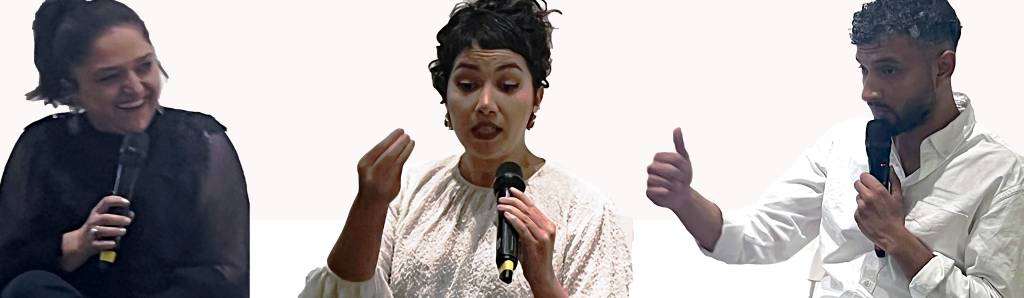
Hilal Seven, Sahar Zand and Yousef Hammash
The theme of World Press Freedom Day 2026 was “shaping the future of peace”. The United Nations designates 3 May as World Press Freedom Day. The Rory Peck Trust curated an exhibition that show-cased a year of world press photos that were published between April 2025 and April 2026, called “Being There”. The exhibition was at the ST .ART Gallery in Eastcastle Street, Fitzrovia, London, from 29 April until 3 May.
The panellists discussed the risks to their lives and wellbeing when covering war, and the dangers of reporting stories that governments don’t want reported – especially in Iran and Turkey.
Kurdish journalist Hilal Seven called for more support for those courageous freelance journalists who seek out difficult stories. She compared our task to a Japanese proverb that tells of searching for an impossible-to-find rare flower; and even if the flower is not found, it is the search and journey that matters. She said that journalism is like that - as it is the search for truth that benefits humanity.
The discussion also covered the terrifying AI technologies that have been used to target journalists in Gaza and Ukraine. Yousef Hammash expressed the grave concern that, because the world has failed to censure Israel for its massacres of journalists, the targeting of journalists in war zones will become standard procedure – as the world is indeed starting to see in Lebanon.
Sexism and racism in the newsroom was also explored, and the call for the need for journalists to show solidarity with each other in the workplace and to not be afraid to argue with editors to get the difficult stories told.
Jon Williams concluded the panel discussion with the pragmatic reality that if consumers lose trust in journalism, then they won’t pay for it: and “if we don't pay for journalism, we're not going to have any journalism.”
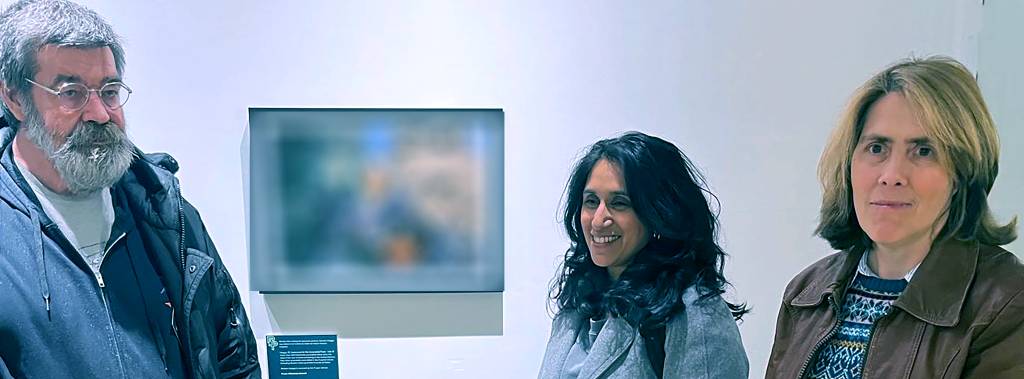
Committee members Mike Holderness, Sophia Akram and Grace Livingstone at the exhibition on 28 April, in front a photo of Gazan photographer Mariam Dagga, for which we do not have a licence
Below are edited highlights from the discussion, including comments by Sky reporter Alex Crawford, who was present at the discussion just after flying home from reporting Israel’s carpet-bombing of villages in South Lebanon.
Jon Williams opened the discussion, telling us “we called the photo exhibition ‘Being There’ because, for all the many changes that there have been and continue to be in the news industry, one thing hasn't changed, which is the importance of actually being on the ground. Every image that you see on the walls here is the result of a decision to go, to stay and to bear witness... because without people on the ground documenting what's going on, then we have no truth. And without any truth, without shared truth, we have no freedom.”
Jon went on to highlight that the International Committee of the Red Cross currently identifies over 130 different conflicts going on around the world. He said this was the most since the end of World War II: “and, increasingly, it is journalists who are paying the price for those conflicts with their lives:129 journalists were killed in the past 12 months in 2025, more than ever before,”
Yousef Hammash told us: “I can speak about my experience of six months inside Gaza. We had two reporters covering for Channel 4 for more than two years.
“People are living in horrible circumstances, with journalists in Gaza living in the same conditions as other displaced people who are living in hospitals and schools... I moved at least five times in the six months when I was there – I stopped counting after that, which is a thing – that we stop counting.
“Journalists are telling the whole story, and they are part of their own story. The systematic targeting of journalists in Gaza also imposes on our own journalism [the obligation] to start reporting our own stories, which has never been the case before... but, again, we saw those stories over and over again, and what was allowed to happen in Gaza. Unfortunately, it seemed that no one was stopping that.
“Journalists are part of their community. They have to be responsible for their children, their families, queuing for water, queuing for food, finding resources, filing [stories] in hospitals – mainly because of the electricity source. And after you risk your life running in the street under raining bombs, you want to make sure that food is being delivered, and people are at least aware of what's going on.
“We could clearly see a shifting of interest to following the other conflicts starting in the Middle East, which has also impacted on the living conditions of Gazans, because the only tool that Palestinians in Gaza have fought with following 7 October is the global outrage, with people outside calling for a ceasefire... And, unfortunately, people have normalised that, with the... how many conflicts? You mentioned 130 conflicts... As long as we normalise what's happening in Gaza, we will see that again and again and again.
“It is our responsibility as journalists outside Gaza to stand up... journalists in Gaza need that commitment... We have commitment from inside Gaza, people risking their lives for over two years, but we didn't see our colleagues outside standing and supporting them.”
Jon Williams responded to Yousef: “260 Palestinian journalists have been killed since 7 October 2023. You told me once a heartbreaking story about those who survived: that even their families view proximity to journalists as a death sentence. And so, the very people who the world is relying on to capture what is going on inside Gaza are being shunned by their friends and their families because they think actually, if they stand too close to them, Israel will kill them as well.”
Yousef Hammash explained: “At the beginning, I experienced that when I was in Gaza. Someone refused to drink in my house because of the [targeting] of journalists. At the beginning, you think,'oh, these people are outrageous', but [their fear is] legitimate. Over 260 journalists have been killed. So, people in Gaza look on them as targets. The community [are] really afraid of having journalists around.
“And we have these small new gangs. All these risk factors affect journalists in Gaza... Also, unfortunately, [we have] the irresponsibility of media institutions and mainstream media; how they were trying to find footage coming out of Gaza... because the Israelis not only banned international journalists, but they also stigmatised every journalist inside Gaza.
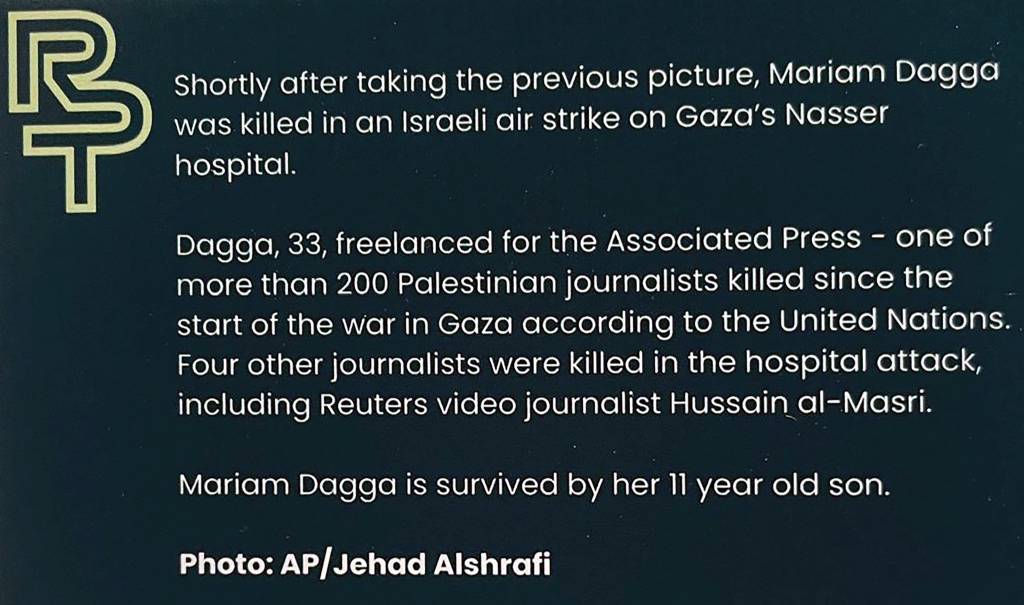
Rory Peck Trust exhibition caption for the photo of Mariam Dagga
“After the world went to other areas, unfortunately, even the mainstream media who relied on these journalists day-to-day, abandoned them... This [targeting of journalists] is a huge risk for the field of journalism, more than the situation in Gaza. It's going to impact everyone.”
Jon Williams: “Reporters Without Borders published its annual global survey of media freedom. And perhaps unsurprisingly, in the 25 years that they've been doing this, they found that the score for media freedom globally was the lowest ever. More than half of the world now lives in places where the climate for media freedom is either very difficult or difficult. Less than 1 per cent live in an environment where media freedom is classed as good.
“There is a sense, isn't there, that what has gone on in Gaza has now spread, in terms of people not allowing access to conflict. So, we saw Israel and Egypt prohibiting access to Gaza... Recently people have been able to go to Iran to report what's going on there. Do you have fears that people just imitate behaviour and when one person gets away with something, other people try to do the same?”
Sahar Zand: “Press freedom is not just about us journalists. It's about every single one of us. It's about the freedom of humanity – and Rory Peck has always provided the support for us to go at a time where we have massive budget cuts.
“To answer your question, Jon, I don't think a lot of countries are copying what's happening in Gaza. I think the Israeli government very much copied what's been happening around the world for a long time, successfully. Look at countries like Russia, look at Iran, look at Turkey, look at China. And what has drawn our attention to it is the fact that the situation there is so black and white. It's so wrong to be killing. innocent people, women, children, men. I hate that we always say 'women and children' as if men's lives don't matter. They're killing people with impunity and shamelessly not allowing reporting and that's nothing new.
“We're not seeing other countries copying it. We're seeing them copying what's been happening for a long time. And, sadly, we have mechanisms in place, international mechanisms, like Interpol, that [facilitate] transnational repression. I did a big investigation on it. And you mentioned the fact that Iran has just opened its doors to journalists to go in and report.
“It's my responsibility to give a platform to the voices I'm hearing often from inside of Iran, which is very difficult. Iran has been in an internet shutdown... They have been risking their lives, getting their voices out through VPNs [virtual private networks], through any means they're able to give their voices. And what they say is that they are very angry at how a lot of broadcasters and press in the West are actually reporting what's happening in Iran.
“Since I was a little girl, Iran has had no freedom of information, no freedom in general for anyone except those in power. Every time there was an election, every time the government wanted to get the public on their side, it would allow a little bit more hair to come out of the headscarves. It would allow tiny freedoms.
“Since the nationwide protest last year... as soon as the world started paying attention to the violation of human rights in Iran... they've allowed women to wear their headscarves slightly looser. And the regime has been using that as a tool to tell the world, ‘Look, we're not that bad'.
“A lot of people inside Iran are telling me that they are angry, that a lot of journalists, wonderful journalists who've been doing excellent reporting, finally paying attention to the situation in Iran, are going there and they are only contributing to the propaganda of the Islamic Republic.
“The Islamic Republic already has a voice. It already has a TV channel and radio and newspapers that allow it to spread its own misinformation and lies and propaganda. Why are news reporters going to Iran, reporting on what the Islamic Republic wants the world to see? Why? Because those journalists go in knowing that they're only allowed to operate inside Iran if they comply with the censorship. So, people in Iran are extremely angry. Thank you so much for bringing attention – but when you use Iran opening its doors slowly as an example of things getting better, it's not, it's only getting worse.”
Jon Williams: “And just on that point, we should make it clear that Iran has also sent or hired agents and hitmen in the UK to target Iranian journalists here, so that a whole television channel, Iran International, had to abandon their broadcasts from Chiswick and move to the United States, because Britain couldn't guarantee the protection of the staff who worked for it. It's a matter of public record, I think, that if your life is at risk, the Metropolitan Police have to deliver what's called an 'Osman warning'. So, [the police] have to give you a letter which warns you that your life is in imminent danger, so that people don't die without necessarily knowing they're being targeted.
Sahar Zand: “They want to kill the messenger and, as journalists, that's what we are. We're messengers. It's nothing new. It's always happened? A lot of journalists have always operated knowing that, especially for those who work in the field...
“The harder it is to report, the more important that news becomes, because there is incentive to hide that news. I know, sadly, a lot of journalists, particularly Iranians, who have to stop doing what they're doing because of that fear. But I know a lot of others who are continuing despite the threat, because they know that the alternative is so much worse, that if we who have voices, with platforms, with faces, with support are being attacked like this, are being threatened, are being forced into silence – then what chance do those people inside Iran have?
“And let me be clear. This is not [just] a threat to Iranians. This is not [just] a threat to journalists. This is a threat to every single one of us. And if we don't stop these situations right now, they are going to impact every single one of us.
“Look at what's happening to media freedom in the US right now. Look at what's happening everywhere. Media is supposed to be the voice of the people, but it also influences the opinion of the people. And if we don't take a stand, and if we let authoritarian regimes... if we don't stand up to them, then we're setting a bad example. We're allowing them to basically abuse their power, to exploit people without any accountability...
“But we need real action and real accountability... That doesn't come from the police. That comes from a real political will.
Jon Williams: “Do you get the sense that clearly some people do care about press freedom, but in terms of priorities for governments right now, it seems to be slipping down and down and down the agenda... They all pay lip service to it, everybody will have issued a statement today on World Press Freedom Day saying that it matters – and yet when it comes to doing something, nobody does anything.”
Yousef Hammash: “Definitely, if you're expecting anything from these governments, they’re complicit; more than complicit, they're actively imposing a genocide. So, what are you expecting for other people?
“Again, I go back to the previous point [that] the whole field of journalism is at risk. And if we didn't stand up as journalists first, you don't start blaming others before you do your own homework.
“We have an issue in the field of journalism, starting with these different editorial policies... who impose their own agenda, on journalists... last year, for example... I did a film for the BBC about four children [in Gaza]. The whole world jumped up and down because it was allowed to be broadcast on public broadcasting and because of this [in the BBC] for a year I'm in investigations, inquiry after inquiry. What everyone knows is there are no mistakes in the film. And that's just a simple example.”
Jon Williams: “Just to be clear, this was the film that the BBC broadcast, narrated by the son of the deputy minister of agriculture [in the Hamas government of Gaza].”
Yousef Hammash: “Again, as journalists, we have an internal issue about standing with each other. What happened recently in Lebanon [with Israel] targeting journalists. We all saw what's happening in Gaza. Hundreds of journalists were killed, and definitely the Israelis are acting with impunity, assassinating journalists.
“When you asked the question about the job: ‘It's crazy to be a journalist’? That’s never been the case. I’ve done this job for 15 years; the Israeli army was around. But when we work in the field of journalism, risk is always there. You think about mitigating risk and not being in harm's way, not being in high-risk areas. There is, as you know, situational awareness. Now it's different. You are targeted. This has never happened. This has never been the case before.”
Jon Williams: “We should just say as well that since Ukraine, the use of drones to target journalists and the use of AI in those drones to target journalists has completely transformed the risk profile. So, Israel has used AI and drones to specifically target individual journalists, and in terms of facial recognition or whatever. Previously it was possible to mitigate risk in hostile environments. To my mind, it seems impossible to mitigate the risk from a drone.”
Yousef Hammash: “The drone or the method they are using, just being a small example, I mean in Gaza, all these calls after the first report ‘those nice calls’ from our cousins (as we call Israelis). So, I was like, ‘okay I need to avoid that’.
“I don't do social media. I changed my phone number – one of my colleagues got me a SIM card from Gaza City and I got a phone from Rafah... I did one phone call, and I received a message from the Israelis, starting with my name. The Facebook message, the audio recognition, the voice recognition – all these AI tools they heavily use...
“So again, dictators, mad fascist people will use and copy what the Israelis did... As an example, you mentioned the US media. just this case of Trump, humiliating journalists.”
Jon Williams: “Let's just pick that up; there is, it seems to me, a rather worrying lack of solidarity. It took quite a lot of Western media 18 months to cop on to what was going on in Gaza in terms of journalists being killed. As Yousef says, in the United States, when President Trump insults female journalists and journalists remain in the Oval Office and don't walk out... how do we get journalists actually to support each other and to stand up? Because if we don't get our act together, how on earth can we expect other people to support us if we don't support our own?”
Sahar Zand: “Well, you're asking a freelance journalist who works in lots of newsrooms and relies on them to pay her wages to tell you what the problem is. And the problem, I will tell you – perhaps if I wasn't so outspoken, I wouldn't be a freelance. The problem is that we're not supported. We are all put up against each other [in] every single place I've worked in.
“We operate in environments where people like to throw around the word 'diversity' or whatever, all of these new words that would make them look good. But if you actually look at how these systems operate, they're run by middle-aged dinosaur men who are not looking to actually take any real action. A lot of my colleagues feel like we have to climb on each other's shoulders. And we become the problems that we're trying to expose in the world.
“There is still sexual harassment. I've been subjected to it. There are still my female colleagues, incredible women, taking their own lives because of the treatment, because of a lack of opportunities, because other people, men, are failing upwards.
“And it's not just a sexism issue. This is just one example. And that's how, in a world where I'm lucky, we're lucky to be getting so much work... I know so many incredibly talented, brave, hard-working journalists out of work, doing Uber deliveries.
“One of them, after driving an Uber for a couple of years, is now going into education. Not that there's anything wrong with that, but it wasn't a choice.
“So, in a world where we don't have any protection, in a world where I have to apply for grants at Rory Peck to be able to get my hostile environment training, or some insurance when I'm in Bangladesh, if for example I’m getting attacked by a mob, I don't get killed, and I get paid in pennies. What do you expect?
“This is about livelihood. We're not heroes. We're not all well-funded. We are people who feel responsible, who care, who have a story to tell, who have gained these skills. And we find ourselves in a system that is not supporting us. So of course, talking about journalists walking out of the Oval Office when Trump says something sexist, that's fantasy. Look at the reality we have to operate in. It's really bad.”
Jon Williams: “Is it fantasy? It did happen in the Pentagon, for example, when they tried to move some of the traditional broadcasters out when Pete Hegseth became the defence secretary? Everybody walked out of the Pentagon “press room”. So, it is possible.
“If journalists don't value journalism, or some colleagues don't value each other, then there's a risk that the audience stops valuing journalism. And how do we try to engage audiences more? Because we're grateful to all of you for turning up on a Sunday, but dare I say, you are the engaged minority: for most people, news is just a commodity that they don't want to pay for. And actually, news is an expensive business. Somebody has to pay for it. And if nobody pays for it, we get no news.
Alex Crawford: “I came here to support you guys, because I think you're fundamental to our journalism. We couldn't get by without people like you. You're all individually inspiring, [I see] incredible work from all of you. Thank you.
“I have a big media organisation behind me. I've had nothing like what you've been through. But every time I get trolled, I've got a corporation behind me and some editors and some colleagues, and that gives me a bit of a backbone that you guys don't have.
“It's a lonely job, even in a big corporation, but you must feel very alone. And that's why Rory Peck is enormously needed and needs to be supported by all journalists.
“And also, just to say, when you're so brave and you're on your own, it's shameful that people who are in big corporations are not just a little bit braver. Because what you've all said in different ways is that we need to support each other. And one of the key things that Jon kept on asking was, 'well, how do we?'
“Yeah, you do need to walk out. You do need to say something. You do need to have arguments with your editors, with your colleagues, with your juniors, with absolutely everyone if they are wrong. And in many cases, they are. And if that involves putting your head above the parapet, there should be absolutely no hesitation in doing that.
“And if that means losing a job or losing credibility or whatever, sorry, that's what we should all be doing.
“One of the fundamental things I think that is wrong in this industry is that we don't value ourselves enough. We're letting people... you mentioned right-wing media... it's actually a few right-wing non-journalists who are propagandists, who haven't come through the training, who are not real journalists. One minute they're soldiers, the next minute they're apparently journalists who are given massive platforms. Even on the BBC, one of the biggest broadcasters in the world, they're given platforms, not as staff, but they're hosted on Newsnight and given platforms.
“That should not be allowed, or at least they should be identified as being propagandists or influencers or whatever. I think that's fundamental, because it's blurring the line between genuine journalists and those who are pushing agendas. And that's making it bad for all of us.
“But anyway, today is about Rory Peck and freelance journalists, who we should all be supporting. And I think it's great that all these people are out here. I thought, 'who would be mad enough to call it on a Sunday afternoon?' Jon Williams, why would you do this? But it's so good that everyone's here. And we should all be supporting each other and trumpeting the good work. All the time, personally. So, thank you.”
Pennie Quinton: “I'm chair of London Freelance Branch of the National Union of Journalists. What I'm really concerned about, and what I think we need all of us as journalists to be doing, is to be challenging the government much more when our colleagues are killed.
“So last August we saw within a fortnight two teams of Al Jazeera journalists taken out in double-tap strikes – the second incident was at Nasser Hospital... What is Lisa Nandy doing? What are our ministers doing?
“We handed a letter in to 10 Downing Street. We got a measly, mealy-mouthed reply that must have been written by some intern. Now, what the hell is going on?
“We need to be protected. We're seeing it across our frontline professions. We're seeing it with medics.
“We are being seen, when we do our jobs, as complicit – and being blamed for covering the ugliness of the world, being made complicit in this context. We've got to stop it. We've got to stop it.
“And Alex, you're absolutely right. We have to argue with our editors, but actually we have to argue with our ministers. We have to be arguing with our leaders. And some of the interviews that I am seeing on television just make me sick. I can't watch the way things are being framed right now. So, we need to up our game. Thank you.”
Jon Williams: It's really important that we speak to the consumers of journalism, because if you don't trust journalism, you're not going to help support journalism... we need to have a public that do trust what is going on so that they're prepared to help fund it. Because if consumers don't fund it, nobody will fund it...
“The work of the Trust is about changing the world one person at a time by supporting and helping people either with hostile environment training or with crisis assistance or mental health support.
“And if people leave this exhibition having understood that actually journalism is valuable – because what you see in these pictures is not just what you literally see, but you see behind the stories in terms of the logistics, the insight, the courage, the contribution that photographers have made to our understanding and our shared truth. Then you're more likely to value the journalism and be prepared to pay for it. Don't pay for journalism, we're not going to have any journalism.”