![[Freelance]](../gif/fl3H.png)
Google is liable as publisher of ‘AI’ output
WHO DO YOU SUE when an “AI” libels you? Its owner - in this case Google - says a German court. If upheld by higher courts, this will have huge implications for the regulation of “artificial intelligence”.
Update: the Court of Justice of the European Union on 16 June stated that “information society services“ are liable for the content and information they control: see below.
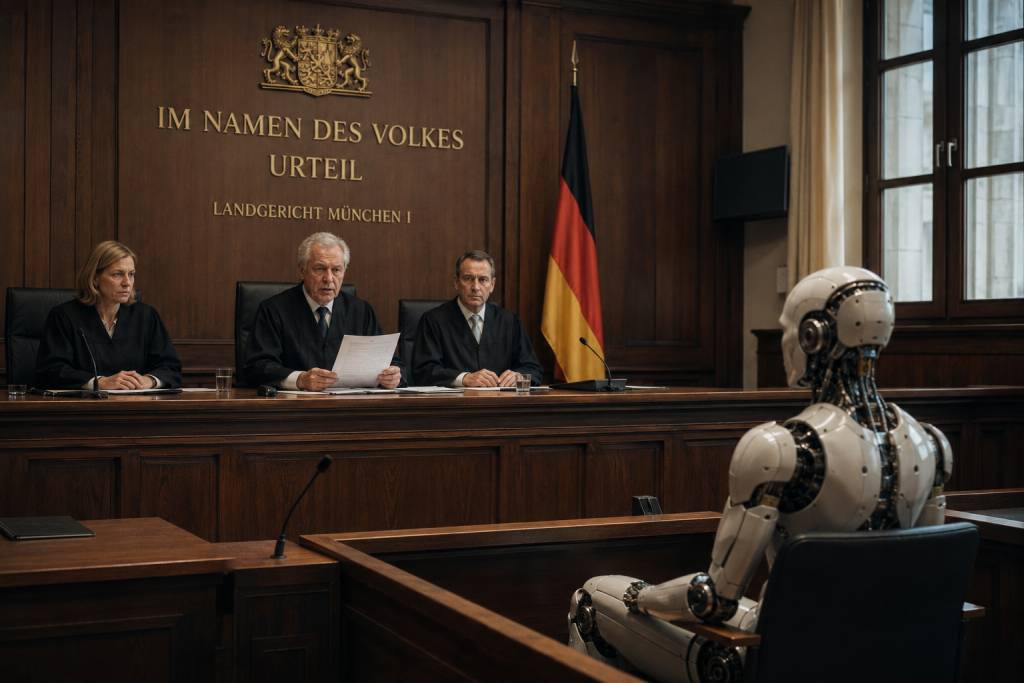
A landscape photorealistic image of an AI in the dock of a German court being found guilty of libel, with the judges showing that they know they are making history, according to ChatGPT, which re-titled it “courtroom verdict with humanoid defendant”. The specific detail that this court is the Landgericht München I (Munich regional court I) is spooky but putting „Im Namen des Volkes Urteil” (“Judgment in the name of the people”) on the wall (not heading a judgment) restores the normal aura of artificial stupidity
Two Munich-based publishers went to court because Google's “AI Overview” feature falsely reported that they had engaged in “scams, subscription traps, and shady business practices for certain search queries,” reports German technology news site the-decoder.com. The “AI Overview” opened with confident claims like “Yes, [company] is known for dubious business practices,” then “wrote” its own summary, with red flags for the alleged scam and tips for users.
The Regional Court of Munich (Landgericht München I) on 28 May granted the publishers a temporary injunction barring Google from spreading these false claims.
The court found that “The defendant [Google] cannot claim that it merely provided or linked to the statements of third parties as search results, because it has adopted these claims as its own, at least to the extent that it based them on its own statements.” In other words, Google is liable as the publisher of the statements.
In respect of one part of the claim the court found that “even insofar as the defendant refers to user reviews on relevant rating portals (Exhibits AG 3 – AG 10), this firstly does not establish the veracity of the statements made therein; and secondly does not provide any reliable information regarding ‘subscription traps’... so that no true factual basis for the expression of opinion has been presented in this respect either.” In other words, if an “AI Overview” presents links to alleged source material that does not, of itself, remove the publisher's liability.
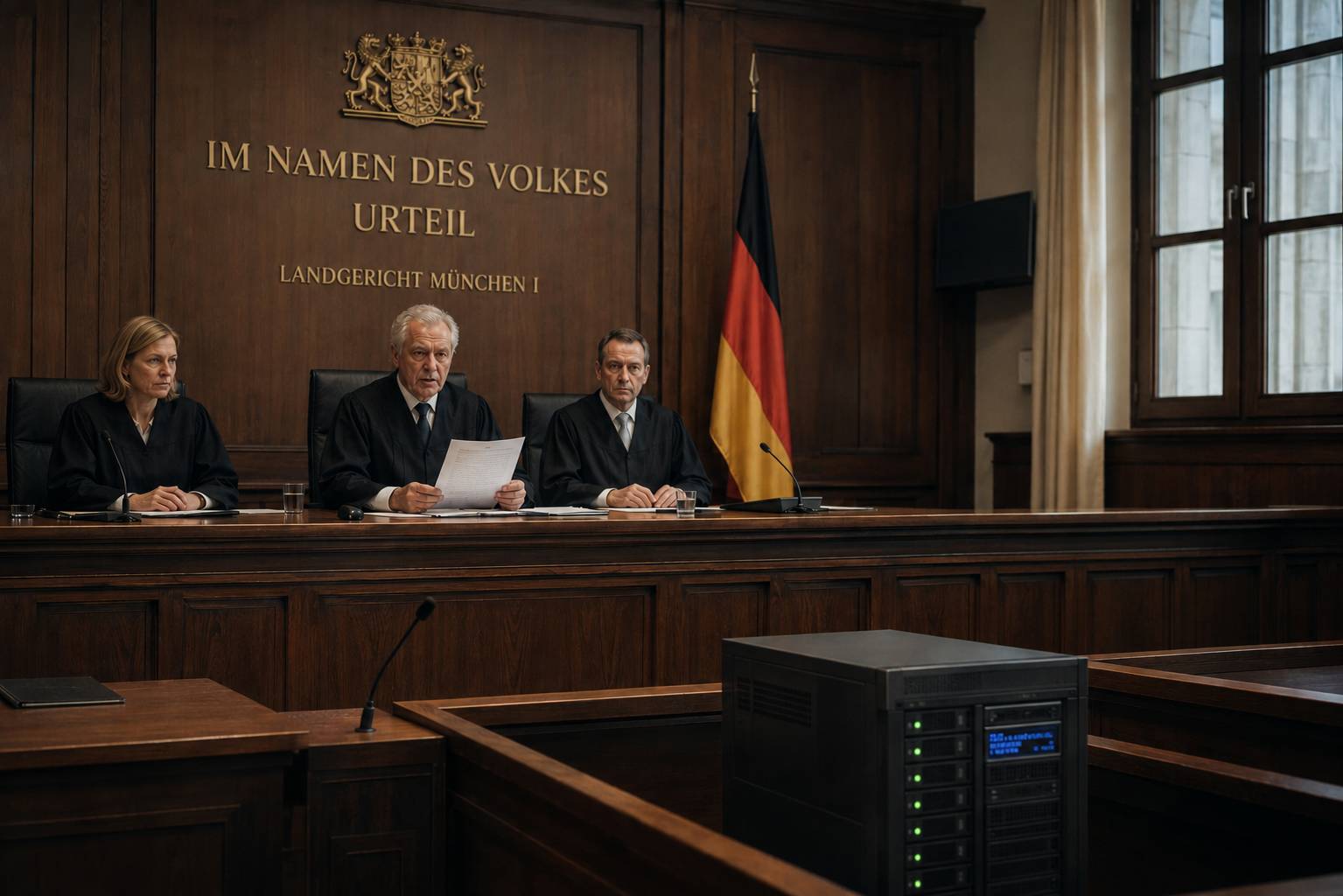
A landscape photorealistic image of a non-humanoid AI in the dock of a German court being found guilty of libel, with the judges showing that they know they are making history, according to ChatGPT, which re-titled it “courtroom verdict with server in dock”. We thus illustrate how tempting it is to anthropomorphise “AI” by preferring the first result, though it plays into “AI” marketing tropes
The injunction covers the publishers' most significant claims of defamation. As German technology news site heise.de summarises its effect: “Google must remove the objected content and ensure that the AI function no longer generates comparable false claims about the affected publishers; otherwise, penalties will be imposed.” Google must pay 80 per cent of the legal costs of the case.
Beyond defamation
The court ruled out a few of the publishers' claims on the grounds that the “AI Overview” was expressing opinions, not making factual claims. Google was therefore protected from action on these points under Article 10 of the European Convention on Human Rights, which opens: “Everyone has the right to freedom of expression.” This defence would not, it seems to the Freelance, apply if Google were to be sued for injury caused by “AI Overview” advice that recommended, say, glue in pizza.
Equally, it seems to the Freelance that since Google is the publisher of “AI Overviews” it may be liable for copyright infringements contained in them. The copyright owner would first have to clear the hurdle of showing that the “AI Overview” publication was not covered by an exception to copyright protection.
Let us imagine other transgressions that an “AI Overviews” might commit: contempt of court, both by breaching orders such as this and by prejudicing the course of justice; publication of official secrets; incitement to violence; incitement to racial hatred... see note. The fact that generative “AI” is confabulating even when its output is right by accident makes it almost inevitable that each of these will crop up eventually.
The court makes the point that its ruling may have effects beyond Germany, mentioning the Brussels I Regulation of 2012 on jurisdiction and the recognition and enforcement of judgments in civil and commercial matters within the EU.
Given these implications it seems inevitable that Google will appeal.
- 13 June: Add to that list of offences and breaches for which “AI” owners may be liable: perverting the course of justice; or perhaps aiding and abetting a perversion of the course of justice. Robert Wright in the Financial Times reports “Police officer under criminal investigation over alleged use of AI” and the Guardian relays “Derbyshire police officer investigated over AI-generated ‘evidential material’”. The unnamed officer is alleged to have used AI to “create evidential material in a number of cases”. Derbyshire Police would not say whether this had caused the collapse of any criminal cases.
- 14 June: Google told Deutsche Welle (or an agency that it credits) that it will appeal: “German court holds Google liable for fake AI answers”.
- 16 June: The Court of Justice of the European Union (CJEU) today stated that “information society services“ are liable for the content and information they control. Specifically, according to the Court press release in English:
“in order to be classified as a ‘hosting’ provider, which may, in principle, benefit from an exemption from liability for the information stored at the request of a user, that provider must have neither knowledge of nor control over that information. As it is, a provider which determines, by means of an algorithm, under what conditions, how and in which order of priority that information is or is not rebroadcast, exercises control over that information, with the result that it is not exempted from liability.”
The full judgment (in the original French) concurs. The CJEU exists to rule on whether EU member states' legislation is compatible with EU law. This case arose with a request from the Conseil d’Etat to clarify EU law while it heard appeals against decrees requiring pornographic websites to implement technical age verification mechanisms and forbidding a satellite navigation program from publicising the locations of roadside checks (such as, we think, speed cameras).
 'Artificial Intelligence' our coverage to date
A step toward reining in Google UK regulates 'AI' search
Landmark German ruling declares Google's AI Overviews are Google's own words and makes it liable for false answers - the-decoder.com
Landgericht München I judgment in case 26 O 869/26 PDF on the-decoder.de
Suchmaschinenbetreiber Google haftet für falsche Aussagen in KI-generierten report on the judgment, from lawyers Beclmann und Norda
Arrêt de la Cour (grande chambre) du 16 juin 2026 eur-lex.europa.eu in French
'Artificial Intelligence' our coverage to date
A step toward reining in Google UK regulates 'AI' search
Landmark German ruling declares Google's AI Overviews are Google's own words and makes it liable for false answers - the-decoder.com
Landgericht München I judgment in case 26 O 869/26 PDF on the-decoder.de
Suchmaschinenbetreiber Google haftet für falsche Aussagen in KI-generierten report on the judgment, from lawyers Beclmann und Norda
Arrêt de la Cour (grande chambre) du 16 juin 2026 eur-lex.europa.eu in French
- Full disclosure: we used a well-known machine translation tool and, yes, we did then check the output to the best of our ability.