![[Freelance]](../gif/fl3H.png)
The trouble with reporting spycops
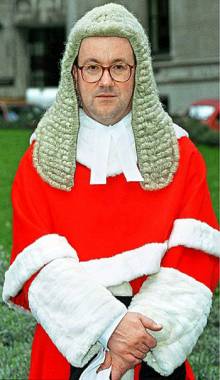
Mr Justice Mitting shortly before his appointment to the Inquiry in 2018
REPORTING THE Undercover Policing Inquiry is complicated, not least by secrecy orders that are themselves secret. The UCPI is the public inquiry into undercover police officers who infiltrated over a thousand political campaigns and groups from 1968 onwards. It resumes on 15 June, with another “tranche” of hearings - this one questioning and cross-examining the managers who ran the Special Demonstration Squad (SDS) unit of “undercovers”.
Ahead of this, there’s an online media briefing for members of the press on Thursday 4 June at 11am. For details, email press.queries@ucpi.org.uk.
You can attend the UCPI hearings either virtually via the International Dispute Resolution Centre at 1 Paternoster Lane, St. Paul’s, London, EC4M 7BQ, near St Paul’s tube.
Registration to attend the next tranche of hearings, which goes on until 5 August, is officially closed. But in practice you can usually get a seat in the public gallery if you show up around 9:30am on the day with photo ID, a press card if you have one and proof of address - and are prepared to submit yourself to a time-consuming search which includes being patted down and having a metal detector waved at you.
You still have a good chance of negotiating access to the Live Link too. The hearing on 21 July may be busier though, and you may have trouble finding a seat for that one: former Metropolitan Police (Met) Commissioner Sir Paul Condon will be questioned on that day about his involvement with the SDS “undercovers”.
It's well worth spending a day at the UCPI if you can. The June, July and August section of the Inquiry (“Tranche 3, Phase 3”) will whizz through the undercovers’ “managers” at breakneck speed, with more than 20 of them testifying. There won’t be much time for each individual manager.
After that we expect at least another two years’ worth of Inquiry. The forthcoming Tranche 4 will look at the undercover officers deployed in the National Public Order Intelligence Unit – the Met’s undercover unit that succeeded the SDS in the mid-noughties and was active until at least 2012.
Tranche 5 will deal with “other undercover policing officers and managers and those affected by deployments” while Tranche 6 will deal with "management and oversight by mid- and senior-rank officers, other agencies and government departments”. There is already talk of bringing forward bits of Tranche 6 to ensure that all the witnesses will still be alive when they’re due to testify. There are no dates yet for Tranches 4, 5 or 6.
Mini-report incoming
An Interim Report is due out from the Inquiry fairly soon. The current Inquiry Chair, former High Court judge Sir John Mitting, will oversee this before his retirement soon after that. We have no date yet for either event.
Mitting’s successor will have to assimilate an awful lot of complex information very quickly to be up to speed by the time they take over as the third Inquiry chair. Mitting took over after the first Chair, Sir Christopher Pitchford, retired in 2017 due to a terminal illness. He died five months later from motor neurone disease.
The Inquiry took a long time to set up: initial hearings began under Pitchford in 2014, but the full Inquiry didn’t start until 2020. See this update by one of the lawyers for Core Participants to the June 2016 London Freelance Branch meeting; and the Inquiry’s revelations in 2020 of spying on journalists back in the 1970s.
At 12 years and 100 days and counting at the time of writing, the UCPI is getting close to overtaking the Bloody Sunday Inquiry, also known as the Saville Inquiry, as the longest public inquiry in UK history.
Anonymity orders
Much time in the years between 2014 and 2020 was taken up with negotiations around “anonymity orders”. Numerous former police officers, including some who have since dies, had their identities protected and can only be referred to by “HN numbers”. These were aliases used in the earlier Operation Hearn, a police investigation into alleged criminal conduct by SDS officers. Some other former undercovers can only be referred to by their “cover names” – the names the activists who were their targets knew them by. We do not know these officers’ real names. Their cover names were often identities stolen from dead children.
All these anonymity orders lead to some interesting “Reporting Restriction Orders” under section 19 of the Inquiries Act 2005 that are in place around the Inquiry. There’s a list of these Orders hanging up at the start of each day in the room where the hearings are held, detailing what you can’t report on. Obviously, we can’t got into detail here about what’s in the list.
Yes, you can live tweet from the hearing (other social media platforms are available). You must wait ten minutes before mentioning anything said. For the next tranche, with the managers, this becomes a 15-minute delay.
Often, the first indication that a Restriction Order has been breached is that the Inquiry staff start marching around the room slamming laptops shut. Then the Chair or an Inquiry lawyer announces an Interim Restriction Order, which usually says you can’t report on anything said in the last five minutes. Often the breaches have been around names of ex-colleagues that a former undercover has inadvertently blurted out.
The Live Link that many depend on to follow the Inquiry also stops abruptly as soon as there’s a breach of a Restriction Order. For various technical reasons, it’s often a long time before it resumes; those following it complain that they often miss crucial bits of the proceedings before its online broadcast restarts.
Some of the anonymity orders are at the request of the many Non-State Core Participants – these include people who came into contact with undercovers through being in the groups that they targeted. Some Core Participants have chosen complete anonymity, giving evidence behind a screen.
Journalist on final warning
One journalist in particular who has been live-tweeting since the beginning and has become the expert on the Inquiry, is Tom B Fowler (@tombfolwler and podcast information at @SpyCopsInfo), a Core Participant who’s been travelling all the way from Newport to cover the Inquiry at its various London venues. Lawyers for the Inquiry let it be known back on 15 February this year that after another of Tom’s inadvertent breaches of a Restriction Order during his 10-minute delayed live-tweeting, Tom was put “on notice” and will be removed from the Inquiry should he commit another breach.
Secret secrecy orders
Part of the problem is that the details of some of the anonymity orders are themselves restricted. So some reporters are breaching anonymity orders in ways that they couldn’t possibly know about.
It’s not uncommon to see one of the Inquiry lawyers walking up to Tom when he’s at work in the public gallery and asking him to delete certain tweets. But Tom is still going strong, he’s now preparing to start reporting on Tranche 3, Phase 3 – his very useful introduction to this is here.
There is now a space set aside for podcasters in the Inquiry’s Delegate Room. (Full disclosure: I am also a Core Participant. My witness statement to the Inquiry is here: see page 18 for the possible impact of police surveillance on my journalism.
The Inquiry’s evidence sessions are mostly held at the International Dispute Resolution Centre. On occasion the Novachok Inquiry into the “Salisbury Poisonings” and follow-up meetings from the inquiry into the Post Office software scandal have gone on in different rooms simultaneously with the UCPI.
Restricted reporting
There seem to be attempts to restrict the questioning of each manager to issues around relationships between undercover officers and activists and issues of racism. Core Participants have been critical of how reporting has seemed to go along with this agenda up to now.
There has been – rightly – much coverage of the deceitful relationships that many undercover officers had with female activists, and of the infiltration by undercovers of family support campaigns in cases of people of colour dying in the custody of or at the hands of the police.
But a brief stint in the public gallery of the UCPI makes it obvious that there should be more coverage as well of the considerable efforts the undercovers and their handlers took to destroy social and environmental movements over a 50-year period.
How can LFB members support high-quality reporting of the Inquiry? Show up to the Inquiry if you can, or follow it online via the Live link above.