![[Freelance]](../gif/fl3H.png)
Government nearly promises action on SLAPPs
THE UK LORD Chancellor said in the House of Commons on Tuesday 19 May: “We cannot allow the rich and powerful to use their resources to stop proper investigation, and I will be bringing forward legislation as soon as time allows.” The Freelance does note that the government of which David Lammy is an illustrious member somehow forgot to include this promise in the King's Speech, which laid out its legislative programme the previous Wednesday; so “as soon as time allows“ may mean “in 2028“.
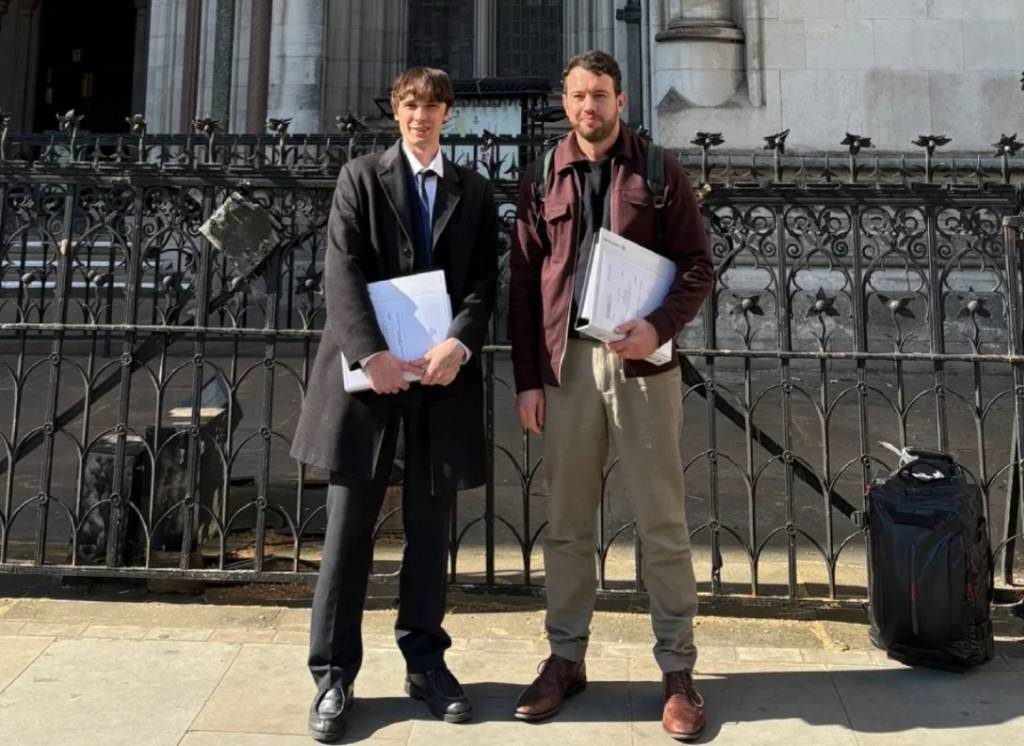
Cormac Kehoe (left) with Mill Media founder Joshi Herrman outside the High Court
The statement fortuitously came the day before it was reported that Mrs Justice Steyn had handed down a sometimes scathing judgment dismissing all claims against The Londoner by Claudio Di Giovanni.
Mrs Justice Steyn quashed a County Court judgment against Londoner journalist Cormac Kehoe for £10,000. Di Giovanni had “brought his defamation claim in the wrong court, without first complying with the pre-action protocol” and had not taken the proper steps to serve notice of this claim on Cormac. The County Court had entered a default judgment in Cormac's absence.
Di Giovanni had “brought parallel defamation claims in the County Court and the High Court against Mr Kehoe in respect of the same publication. That is an abuse of process,” Mrs Justice Steyn ruled. She granted the defendants' application to reject Di Giovanni's High Court action. He had not properly served notice of that either.
As the Freelance understands it, the question of the court declaring that the claim was ”a statutory SLAPP” did not arise because it was, in effect, ruled not to be a case at all. Mrs Justice Collins Rice did make such a declaration in slapping down a case by Setu Kamal against tax researcher Dan Neidle in March.
Lawyers at odds
David Lammy's 19 May statement was in response to a question by Brian Leishman, Labour MP for Alloa and Grangemouth, expressing “concerns about recent reports that the Society of Media Lawyers, which opposes the reform of strategic lawsuits against public participation, has had significant access to Ministers and civil servants while lobbying against stronger protections for journalists...”
On the other hand, the Freelance is somewhat heartened to discover a warning notice from the Solicitors Regulation Authority (SRA) going in to extreme detail about when a solicitor agreeing to work on such a case can be a breach of professional standards and concluding that disciplinary action may be taken.
On the inevitable third hand, one of the effects of that SRA advice is likely to be that more aggrieved people try to represent themselves in court - as both Di Giovanni (a property developer) and Setu Kamal (a tax barrister) did. Defending a case brought by a plaintiff in person can be even more expensive than one argued professionally.
- 26 May The judgment in Claudio de Giovanni v Cormac Kehoe & Ors was handed down on 13 May; we do not know why it took a week to report it.
 Claudio de Giovanni v Cormac Kehoe & Ors nationalarchives.gov.uk
‘Scamming’ landlord libel claim thrown out as Lammy promises legislation on SLAPPs pressgazette.co.uk
We won our defamation case! the-londoner.co.uk
Claudio is scamming the article complained of, on the-londoner.co.uk
Judge slaps down SLAPP-SLAPP claim Mar 2026
It’s the costs, not the damages Duncan Campbell at our March 2023 meeting
Claudio de Giovanni v Cormac Kehoe & Ors nationalarchives.gov.uk
‘Scamming’ landlord libel claim thrown out as Lammy promises legislation on SLAPPs pressgazette.co.uk
We won our defamation case! the-londoner.co.uk
Claudio is scamming the article complained of, on the-londoner.co.uk
Judge slaps down SLAPP-SLAPP claim Mar 2026
It’s the costs, not the damages Duncan Campbell at our March 2023 meeting