![[Freelance]](../gif/fl3H.png)
What are public service media in the age of TikTok?
WHAT WILL it mean to be a “public service broadcaster” if everyone is watching narrowcasting selected just for them by the algorithms at TikTok and YouTube? Freelance editor Mike Holderness has some thoughts; and the prospects are far worse than he first thought, threatening the BBC and any other public service: update.
 Defend public service broadcasters Freelance response to the government

It was coming together: the Channel 4 launch logo
I VIVIDLY remember the opening night of Channel 4 TV: the books programme; the intelligent news broadcast; the parts of the station logo sailing into view - in a video engineering feat by the standards of 1982 - over the end of the transmission. My television viewing choice had just increased by 33 per cent and it was looking good. Now, do I remember correctly that the last show of the first night featured the music of Philip Glass? Let's search YouTube for pirated versions...
Channel 4 was the answer to an urgent question about the meaning of “public service broadcaster”. Now YouTube and TikTok, most prominently, are posing the question again, and the UK government is holding a consultation on some responses.
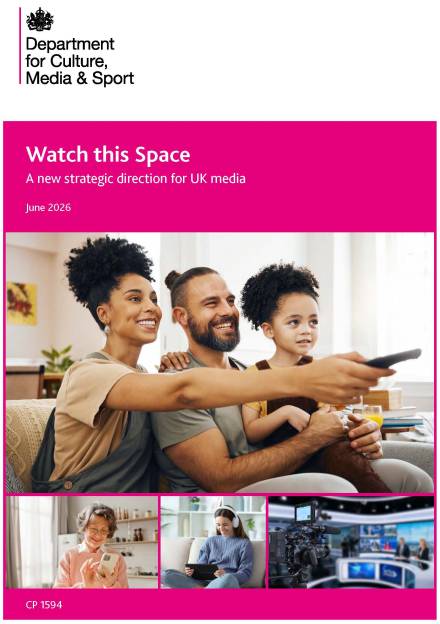
Graphic design is my passion: the Green Paper cover
Can the TV as a “national hearth” - a gathering point for a cultural identity - be restored? Probably not. But there is a concrete need to tackle misinformation and disinformation and restore the notion that there is such a thing as “truth”.
Government expresses concern about the effect of social media on young people; I fear I have lost one dear old anarchist friend and one elderly Cockney relative, gone completely off the rails down the same path from half-formed worries about vaccines to believing any old far-right conspiracy presented by the algorithms that lock them in to their “preference” for watching things that amplify the last lie they saw.
The UK government has some - rather modest - proposals in a public consultation and Green Paper. The major headings are:
Prominence
Should the be a requirement to give public service media (PSM) prominence in online listings? Absolutely, I say - everyone needs at least to be reminded of the existence of proper reporting, subject to regulation. Until a news report has been sub-edited it's just a reporter saying what they think.
I have an important proviso. There should be a “mosaic” of results on all listings, with PSM making up perhaps a third of the top 20 results. That way viewers clearly have a choice and self-publishers have a chance to appear at the top among the big players.
If anyone has any ideas for ways to give some preference to broadcasters such as Deutsche Welle - whose English service I now have open on my phone - and for ways to persuade the UK government to adopt them - I would be very interested to hear both.
Media literacy
Should there be a drive to promote media literacy? Probably. The NUJ has already said that such has stressed that “any obligation must come with additional, demarcated government funding”. I note the remarks of NUJ General Secretary Laura Davison in an initial response:
“these proposals follow the announcement of brutal cuts at STV and the BBC, where thousands of jobs and programmes are at risk of being lost. To safeguard access to accurate, high-quality news and information, the government must urgently intervene to protect jobs and the future of public service media.”
The NUJ supports a nationwide media literacy initiative led by public service broadcasters, including the BBC, but stresses that any obligation must come with additional, demarcated government funding.
Institutions
Should PSM continue to be defined by the institutions that produce it? Yes.
The alternatives - a somewhat loose concept of narrower “channels”, or awarding PSM status to individual programmes or videos - conjure up a regulatory hellscape that includes a government body that decides whether small channels or individual videos make the grade. No to that.
The great turn-off
Ah! Here perhaps we have the motivation for the consultation. Should the existing digital TV transmitters be turned off in 2034 or in 2044, to be replaced with TV delivered over the internet?
I am deeply sceptical about turning them off at all. Consider the problems already encountered with turning off traditional telephone service: no-one can make an emergency call from a landline during a power cut. Consider the role of broadcasting in getting information out during a natural disaster.
But if they do turn the transmitters off, the government can hold an auction of the radio frequencies they use. Leasing these to the likes of Jeff Bezos and Elon Musk is likely to be very lucrative.
Watching this space...
I am surprised by the relatively small amount of polemic against this Green Paper so far. What there is seems to come from the sort of “free speech” advocate who is mostly concerned with their own freedom to spread racism or global heating denial or both. I do expect Alphabet, owner of Google and YouTube, to lead the charge shortly - if only on the grounds that “No-one Tells Google What To Do.”
Update
Bastille Day, 14 July 2026 It seems that Alphabet/Google is pressing YouTube creators to do its lobbying for it, opposing the requirement of prominence for PSM. And the message we have heard one deliver is “do not force people to watch state broadcasters.” That may well appeal to otherwise rational YouTube consumers.
If Google gets its way on this, and the government gets its way on selling off the TV airwaves, UK public service broadcasting would cease in 2034. From then on the only thing determining what news video citizens were regularly exposed to would be Google's YouTube algorithm (and those of any other services that people actively opted in to).
To spell it out: the government specifically mentions PSM using YouTube to distribute video after that switch-off. So if you went to quickly check TV news you would be presented with Google's choice of shows. The BBC - and Channel 4 and ITV - would essentially be “content creators” competing with Fox News and Steve Bannon and other “influencers” to game the algorithm and appear prominently. This is being promoted as prioritising “the user's own preferences”. It is hard to express how wrong that is.
- The deadline for responses to the consultation is 31 August.
Defend public service broadcasters Freelance response to the government
Better back BBC - BEAU petition please
UK government publishes media green paper nuj.org.uk
Channel 4 schedule for Tuesday 2 November 1982 ctva.biz - I was likely wrong...