![[Freelance]](../gif/fl3H.png)
Why did Klaus Thymann end up jailed in Uganda?
KLAUS THYMANN revealed the bizarre chain of events caused by his e mail calling for help to UNESCO’s Paris-based journalist safety unit being leaked and how this seems to have got him banged up in Uganda. Now he is demanding to know whether an organisation that exists to help journalists catastrophically failed him.
GEOGRAPHER and journalist Klaus Thymann spoke at the July branch meeting about his arrest and imprisonment without charge on 29 June in Uganda. Klaus was commissioned by the National Geographic for a photographic assignment connected to research he’d previously carried out with the support of the Ugandan government to measure the area and thickness of glaciers on Mount Rwenzori, the third highest mountain in Africa.
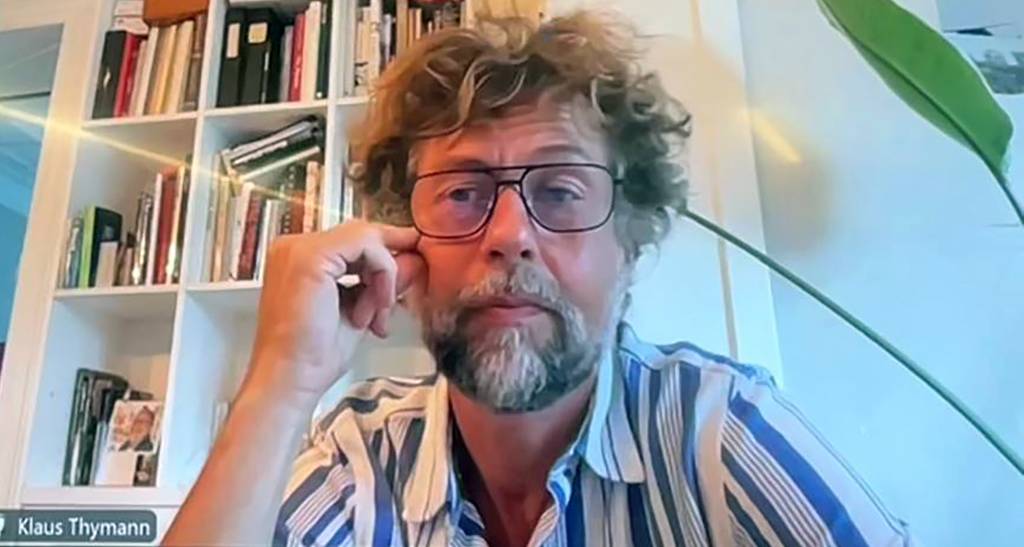
Klaus was released from prison in early July following interventions from the Danish Embassy and the NUJ, He told us that the only evidence he saw connected to his arrest and unlawful imprisonment was that the police had a copy of an email he had sent to the Paris-based journalist safety unit of UNESCO, the United Nations Educational, Scientific and Cultural Organization. The email concerned issues with fixer payments and being granted access to his research site on the Rwenzori Mountains, which is partly monitored by UNESCO. He outlined to us a chronology of events that led to his arrest as a “classic” of “how do you shut up a journalist?”
“But” he asked “what’s the motivation for this, because I report primarily environmental issues, glaciers, nature. I’ve been to Uganda five times before, and it’s been… positive journalism about the landscapes, the parks, the people, and so on, and there haven’t been any problems.
“The place I go to is called the Rwenzori Mountains. It’s the third highest mountain in Africa. I find it particularly interesting because it’s a white spot on the map. In the old days, the explorers, they would take a piece of paper… they were always colouring maps… In 2026 there are still white spots on the maps.
“There’s a lot of ocean sea floor that we don’t know anything about… we don’t know about terrestrial areas… and those are the places that fascinate me. I started work in 2012 in the Rwenzori Mountains, gathering comparative photography, going all the way back to 1908. Using comparative photography, you can map places, not only to document but also to calculate. That’s what I’ve been doing.
“The park is administered by the Uganda Wildlife Authority (UWA), a government organisation. They’re armed and they protect the rhinoceros, so people don’t steal their horns, or the elephants’ tusks… they also take care of the mountains.
“The mountains there are particularly interesting for me because I work with glaciers and going to about 5000 meters, there’s ice always there – on the equator. The reason that there’s very little data from there, very little science, is that it was a conflict zone for a long time. It is on the border with the DRC [the Democratic Republic of the Congo], and it just wasn’t safe.
“Then, there’s so much cloud cover that the few satellite images you get are a mush. If you look on Google Earth, it’s all nonsense. So, for a long time, I was the only scientist – I still am the only scientist – who has a record that goes back.
“In 2020 I did an expedition to create a drone survey of the mountain. By taking enough pictures, it’s possible to create something called photogrammetry… essentially you can create a 3D photorealistic object. If you geo-reference it you can also calculate areas using that photogrammetry.
“UWA helped with the logistics of my expeditions. We were sometimes more than 50 people… 50 local people. UWA gets paid and they provide the teams... Often, it’s the same people I work with on these expeditions. And in 2024 I led an expedition to calculate the depth of the ice and the area of ice.”
“The scientists I was with were going to calculate the depth using ground-penetrating radar. That was a massive failure: it didn’t work. I then came up with another methodology; we could deploy time-lapse cameras, not one but two, and then we could have a stereo image, a 3D time-lapse image of the mountain. And if it was 3D, and with geo-reference, then we could see the depth of the ice as it recedes.
“In 2024 and 2025 UWA supplied the team. When I went this time in 2026, it was to conduct photography for National Geographic. So, I was just there as a journalist, not doing science. I decided to work with an independent trekking company that I worked with before called Rwenzori Trekking Services.
“During the expeditions in 2024 and 2025 we had discovered that the payments were made into a private account, not to an UWA account, and it was a dollar account that went through New York, through Citibank. People who were supposed to get paid locally weren’t, and complained, so we thought, let’s go with Rwenzori Trekking Services.
“When you go to the park you don’t have to seek permission in advance – you can just pay the entrance fees. But I get stopped by seven armed rangers in uniform and by an official who pointed a gun at me and said, ‘you’re not going in’. Then they pulled me aside, away from my team, and demand to talk to me separately. I said that’s not going to happen. So, I brought two witnesses. Then they told me, ‘This is not going to end well, you can’t enter’, and asked ‘you know why?’
“And I was like, ‘because I’m not paying you for the handlers, is it? I don’t know. Tell me.’
“At that point, I got very concerned.
“For context, the Rwenzori National Park is also a UNESCO heritage site. UNESCO is not directly involved in the administration or the running of the park, but it has a working relationship with it. So, I thought, what I’ll do, is I’ll send an email to the lead of the UNESCO safety for journalists team. I wrote that I was at the point of fearing for my safety, and finished the email, in capital letters, ‘PLEASE HELP’. She didn’t reply. And the next day my lead guide or fixer was called down to the UWA office, the local one in Kasese, and was told, ‘Well, you can pick up the permit.’
“He went down there with the exact amount that you have to pay: we were three people– only foreigners have to pay – and with copies of passports. Then he was arrested. He texted that they’re looking for me, but I’m not sure whether it’s him or whether it’s the police who had his phone… But UWA has my contact details, my email, phone numbers, they have everything. If they wanted to see me, they could contact me, but they didn’t.
“Then over the weekend, I emailed another team from UNESCO, Natural Heritage, who are most in touch with the park, and asked them to help and they said they’d spoken to UWA about this; they really don’t have a problem with me entering the park. I read that as ‘OK, fine, this is all sorted out. You can go’. I said that I still would really like to have an appointed contact person from the safety for journalists team. That’s ignored.
“On 28 June the president’s son, and next in line to the throne, made a fantastic statement publicly in Uganda: ‘I do not believe in free press’ and demanded that ‘From now on ALL bad stories about Uganda have to be cleared by my office!’
“My team received a message from John MaKombo at the UWA in the capital, Kampala, saying that I should go by the office and discuss things.
“I was thinking OK, UNESCO have informed him that they agree with my mission and reporting... The local team in Kasese that were after money have probably been told off, because I thought this was a local matter and they were just annoyed they didn’t get paid.
“But at the point I had made contact with somebody from the NUJ and discussed the situation. On Monday I went to visit the Danish Embassy, I have a contact there. I also deposited some paperwork – I emailed it to the Danish Embassy, in case something should happen, so they have it.
“At that point I downloaded all the WhatsApp messages I’ve had with anyone to a secure server. I put all my emails on the secure server. I put all contracts, whatever we have. So, it’s offline also.”
WhatsApp tracking
“Over the weekend, the police tried to track me. And I think this might be interesting for people to hear how this works. “On WhatsApp, when you send a message it goes from a phone to a server to a phone, via an encrypted server. So, unless you’re Israel or somebody that uses Pegasus [spyware], your message is not really something you can track easily. But for a phone call on WhatsApp, (which is not a phone call, it’s a voice call by IP) – to improve the sound quality, the two IP addresses are linked directly.
“It’s possible to use some software to locate the IP address when the other person picks up. Over the weekend, my fixer tries to call me. I don’t pick up. I send a proof of identity question to him, which he fails, and then I block that person.
“Anyway, I go to the UWA office and on that Monday, I have a meeting, but they arrest me afterwards.”
It gets weird
“This is when it gets weird. They don’t charge me. I have no idea why they’ve arrested me and they don’t tell me. I spend the night in prison, but I’m not charged. I managed to smuggle in my phone, so I can use that from the cell, so I can communicate with my team.
“I had set up a panic button with Tim, my Ugandan lawyer who I had hired for the fixer to help my wife and some other people in case I got arrested… so they could coordinate…
“Then the next day, together with all the other prisoners, they call us out to announce charges. But they don’t read me any charges. Which is both very strange and probably the most concerning thing, because if I don’t know what I’m charged for, that’s a real concern… My Ugandan lawyer is told that ‘Klaus doesn’t think Uganda is safe, we’re keeping him safe in prison’.
“I’m like, what? That’s a little bit cryptic. What’s that supposed to mean? Then I get transferred to Kasese [the capital of the region that includes the park] There I’m with two other people in a very small cell. And they keep me there. They don’t charge me. After two days, that’s a violation of Uganda’s constitution. They have a 48-hour pre-trial period, then you have to go in front of the judge. It’s also a human rights violation. They confiscate my laptop, so I don’t have access to evidence, also a human rights violation….
“On the Wednesday, they call me into a room where there are 16 investigators sat around me, also behind me, and they just shout questions at me. They have really accelerated the good cop, bad cop experience. There are multiple good cops and multiple bad cops. It’s like a multi-player game. But they’re like, ‘Yeah, if you just talk tomorrow, you’ll go free.’
“I’m like, ‘Yeah, sure, great. I’ll speak with my lawyers here’.
“They say ‘Yeah, but you just have to talk to us, what are you afraid of?’
“‘Everything, so that’s why I’m not speaking to you.’
“‘Yeah, but if you just… why won’t you talk?’”
“‘I’ll speak when our lawyer gets here’, and it gets a little bit boring after an hour repeating that, but I just repeat that.
“The Danish Embassy is also in full motion, and on Wednesday night the lawyers arrive and the Embassy sends somebody at five o’clock in the morning, who arrives at like 12:30. At that point they’ve agreed that I can talk to them without interruptions and they will sit in front of me, not behind me. They’ve also asked enough questions that I figured out that they have something like espionage charges, like national security charges that they are investigating, but they still haven’t charged me.
“I tell my legal team that I think the best way to deal with this is to be completely transparent and honest and I would like to explain the situation. They say that’s a risky thing, but I don’t have anything to hide, I really don’t and I think it’s the best…
“So, I explain to them why I had come, that I love Uganda, I love the people, and I don’t want anything bad to happen to Uganda. But if it comes to my freedom versus damaging Uganda’s reputation, I will choose my freedom. That the time-lapse cameras that I installed are not spy cameras, and that they were donated to UWA, and there’s a paper trail of that. I don’t own the time-lapse cameras; they’ve been to the mountain and taken them down. The cameras are also in the room.
“We also conducted training on how to use them and the only way to take the data – there’s no Wi-Fi on the mountain in Uganda – is to go and take out the SD card. That training was filmed as well. And there’s a training manual that they received. In the meeting it is all the police investigators, but also some people from UWA who are the ones that have filed a complaint to the police about this. And a little bit unsurprisingly, it kind of unravels, all of it.
“The police start questioning UWA about what they did and ask, ‘what this is?’ They don’t say it’s not by the book, but it becomes obvious that they are very critical of what UWA do. It ends with the police saying that they want to free me. Whether this is just because of my very well-documented innocence, or also because of the diplomacy that was taking place simultaneously with the Danish embassy and the ambassador and the whole team from Denmark pounding the government and everybody else to look at this case…
“That’s how it ends. They say they have to free me but have to wait till the next day or even the next day The local team in Kasese say, ‘oh, they can release me, but I have the administrative issue with UWA’.
“I don’t have any administrative issue with anyone. ‘If you file a police report and you don’t charge me, I’m free and, by the way, you violate all these human rights laws and your own constitution. I think we’re done’.
“They try to insist they want to release me on police bond, meaning that I have to report to UWA…The representative from the Danish embassy is adamant this does not happen… I’m free, but then I have to give a statement, they want a written statement for their file.”
‘One piece of evidence’
“When I’m due to give that statement, they show me one piece of paper, the only evidence I’ve seen for five days, except for the cameras …it’s the email that I sent to one person at UNESCO, the lead for the safety of journalists, the email that finishes ‘PLEASE HELP’.
“And they go, ‘why don’t you think it’s safe in Uganda? And I’m like, are you being ironic? I’m sitting here and I’m facing fake espionage charges. No, it’s not safe. That’s still an email that somehow ends up with the UWA that was sent to one person at UNESCO with my wife on CC, nobody else.
“If that message hadn’t ended up with the very organisation that I was seeking protection from, this probably wouldn’t have gone so far, and I wouldn’t be in the process of figuring out how to potentially file a claim with UNESCO.
“UNESCO told Danish media that it didn’t share confidential information, which I see as a very clever way of saying, we might not have breached our own internal protocol because we don’t think this classified, but we could have shared the email.
“The maximum sentence, I think, for the charges ran to over 30 years. That was the biggest concern. The physical environment for five days is something that I can live with, but being in prison for decades is not.
“I received an apology from the police. I received an apology from the legal counsel at UWA. We’ve asked for them to be investigated. One is the director of UWA, who has only been there for about a year and a half and was not necessarily privy to how the cameras were installed, so it’s possible that he was blindsided by his own employees who tried to frame it.”
Klaus still wants to know how his email asking for help ended up in his accusers’ hands. He concluded by thanking the NUJ for its support.
The meeting agreed to ask the Branch Committee to consider further action. Klaus also asked us to publicise a GoFundMe page asking for contributions to help cover the costs of his efforts to secure his release in Uganda.
 Defending Danish journalist Klaus Thymann arrested in Uganda