![[Freelance]](../gif/fl3H.png)
London Freelance Branch chair’s report 2025
FIRST: thanks to all the many London Freelance Branch members who have attended meetings and raised issues and points for discussion.
2025 has been a deadly year for journalists: and I am proud of how our Branch members stood in solidarity with their fellow journalists: when their equipment was seized under spurious applications of anti-terror legislation by the UK police; or when their jobs were on the line at the Observer, the Mirror, or through the cuts to freelance contracts at the BBC.
I want to express my gratitude to LFB Committee 2025 for being excellent and for generously giving their time and talents for free to contribute to the running of the branch.
Thanks to Tim Gopsill, who after I was elected branch chair at January’s AGM took on the role of vice chair early in the year and prepared the necessary paperwork for the LFB delegation to the NUJ Delegate Meeting in Blackpool. Thank you, Tim, for continuing to manage branch affairs while I recovered from surgery.
Thanks too to Grace Livingstone for stepping up as vice chair in September and for her excellent support of the branch, particularly at the vigils we held this year in the face of the unprecedented targeting and killing of our colleagues reporting in Gaza.
Massive thanks to Phil Sutcliffe, who was an excellent branch treasurer – his marvellous talent for pouring oil on troubled waters has been invaluable in the past year – and for taking care of the sandwich order for branch meetings and for organising the food and drink for the December celebration.
Thanks to Mike Holderness and Nika Talbot: Mike as Freelance editor and Nika as social media officer who shared the role of Branch Secretary organising branch minutes and mailings.
Thanks also to Nika for her excellent work as social media officer, publicising Branch meetings and many more events over the year and for sourcing the excellent LinkedIn coffee morning and organising the social media “how to” sessions.
Thanks to Mike Holderness as Freelance editor, for all his work maintaining the Branch website and for putting up with me as deputy editor producing the Freelance print edition.
Thanks to Mariam Elsayeh, who in her role as training officer has organised the legendary members’ coffee mornings. Thanks also to Adil Raja who as well as fighting an important SLAPP case targeting his reporting, and now a demand for his deportation, took on the role of second training office in the latter half of the year.
Thanks to Shaimaa Elhadidy for her excellent work as membership secretary, and thanks to Phil and Shaimaa for organising the new members’ meetings. We hope in 2026 to have a few of these as hybrid events.
Thanks to Helen Hague and Nadim Baba for taking on the welfare officer roles.
Thanks to Deborah Hobson, who as well as being a lay member of the committee also serves on the NUJ National Executive Council (NEC) and writes reports on its doings to share with the committee and branch.
Thanks to all the LFB Committee lay members for their contributions: Taoufiq Abuzaid, Jem Bartholemew, Ahmed Elkaoud; Owen Holdaway; Ashraf Khan; Tony Levene; Francesca Marchese, and especially to Anu Shakula, who organised the playlist for the December party.
Finally, thanks to David Ayrton as Freelance Organiser, to Andy Smith who shared that work for much of the year and to Tim Dawson who was appointed in June.
Branch events in 2025
Following the election of the new branch Committee at January’s Annual General Meeting we heard from photographer Guy Smallman, who had finally got his equipment back from the police. Guy reminded us that on 25 June last year he was arrested, as he put it, “for the crime of doing my job” – which at the time of his arrest and equipment seizure was covering a peaceful, theatrical protest by “Youth Demand” in the grounds of the country home of Rishi Sunak, who was at the time a prime minister.
At our 10 February Branch meeting Nika Talbot spoke about using Substack and Tom Davies updated us on the Guardian and Observer strike over the Scott Trust’s sale of the Observer to Tortoise Media.
On 10 March we heard from Carole Cadwalladr on the fate of the Observer – and being sacked twice in one day. Thanks to Jem Bartholemew for arranging for Carole to speak to the branch.
In early April, as I was just back from sick leave, I was privileged to lead our branch delegation to the NUJ Delegate Meeting in Blackpool, where all LFB motions were approved by the delegates, apart from one motion which we agreed to remit to the NEC. Thanks to all the LFB branch delegates for their dedicated service: Juliet Davies, Mariam Elsayeh, Helen Hague, Owen Holdaway, Tony Levene, Nika Talbot and Susan Wallace: and thanks again to Tim Gopsill for getting everything ready for the delegate meeting.
On 14 April Althea Billings and Jenka Soderberg of KBOO radio in the US spoke to the branch on the impact of Trump on free speech, journalism and his threats to public broadcasting in the US.
On 28 April members of the Branch marked International Workers Memorial Day with a vigil as St Brides's, the journalists' church on Fleet Street.
On 12 May Peter Oborne spoke to the branch about the British government’s complicity in genocide.
On 14 May John McDonnell MP asked a question in the House of Commons about the arrest and administrative detention of veteran journalist Ali Samoudi by Israeli forces. Ali remains held without charge, with his detention continually being extended at military court hearings.
On 9 June Taha Siddiqui, a journalist from Pakistan and founder of the Dissident Club in Paris, spoke to us about his graphic novel on exile. Asa Winstanley shared the good news of getting his equipment back from the police; and we sadly remembered our legendary member, the crime reporter Duncan Campbell.
On 7 July the branch held its annual meeting in parliament – sponsored by John McDonnell MP, the secretary of the NUJ parliamentary group, as a teach-in on “how to report the Gaza genocide”. We listened to Ben De Pear, the CEO of Basement Films, on the difficulty of getting Basement’s Gazan Doctors under Attack documentary broadcast on the BBC; producer and researcher at Basement Menna Hijazi spoke, mentioning seeing footage of her childhood home being bombed; followed by Dr Pete Chonka from the department of Digital Humanties at King’s College London. John McDonnell updated us on his work to highlight the horrific situation for journalists in Gaza with ministers.
At the Branch meeting on 14 July we heard from NUJ General Secretary Laura Davison and Financial Times Parent of Chapel Steve Bird on freelance organising for better rates of pay.
On 27 July we held a branch summer social and picnic in St James's Park, where we herded deckchairs and whiled away a beautiful Sunday afternoon.
Traditionally there is no LFB branch meeting in August.
Shock waves went through our profession on 11 August when Israeli forces deployed an airstrike on the press tent outside al-Shifa hospital in Gaza, assassinating Al Jazeera reporter Anas Al-Sharif; camera operators Ibrahim Zaher and Moamen Aliwa; their assistant Mohammed Noufal; correspondent Mohammed Qreiqeh; and the freelance photojournalist Mohammed Al-Khaldi.
We held an emergency LFB committee meeting to discuss our response to this horrific crime, where we were joined by John McDonnell and Peter Oborne – and organised a vigil on Wednesday 13 August opposite Downing Street. The 13 August vigil was addressed by NUJ general secretary Laura Davison, John McDonnell, LFB training officer Mariam Elsayeh and LFB chair Pennie Quinton. Journalists held placards, each bearing the name of a journalist killed in Gaza and read out their names one by one.
On 25 August Israeli forces killed yet another five journalists in a “double tap” strike on Nasser Hospital in Khan Yunis: Hossam Al-Masri, a photographer working for Reuters news agency; Mohammed Salama, a photojournalist working for Al Jazeera; Maryam Abu Deqa, a journalist working for Associated Press and Independent Arab; Moaz Abu Taha, a freelance journalist working for NBC news; and Ahmed Abu Aziz, a freelance journalist working for Middle East Eye.
Following this second atrocity the branch on 27 August delivered its letter to the Prime Minister with an addendum on the most recent killings. The letter was co-signed by the NUJ’s London Central Branch; London Magazine Branch; London Digital Media Branch; officials of the Financial Times Group Chapel; Brussels Branch; Ethics Council and Photographers’ Council. It was also supported by Khaled Shalaby, head of video operations for Middle East Eye – who had seen his colleague Ahmed Abu Aziz killed at Nasser Hospital just two days previously; and by Sarah Beddington, writer and director of Fadia’s Tree, an award-winning film about Palestinian exile.
The letter demanded to know what actual action the Prime Minster will take to address the mass killing of journalists.
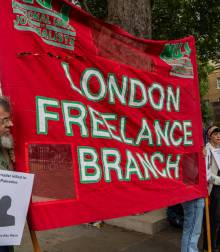
Once more we gathered in grief opposite Downing Street with the Branch banner and another saying “stop killing Palestinian journalists”. As people arrived, they each took a placard with the name of one of the journalists killed and formed a long line stretching up towards Trafalgar Square. Branch chair Pennie Quinton opened the speeches, saying “to kill a journalist is a war crime”.
We played the recording that Wael Dahdouh of Al Jazeera had prepared especially for our event and Mariam Elsayeh read the English translation.
Broadcaster Sangita Myska described Palestinian journalists as “the bravest people in the world... they continue their work despite Israeli attacks and threats. But the West belittles their profession. At Nasser Hospital,” she said, “Israel, like terrorist organisations, carried out a second attack on those arriving at the scene after the first strike... If Russia had killed five journalists on live broadcast, do you think the British media would have ignored it? I don’t think so. A Palestinian journalist being killed is not just the death of one person – it is the death of journalism.” Sangita’s speech attracted wide attention, including an endorsement from singer Annie Lennox.
Palestinian journalist Ahmed Alnaouq, of Palestine Deep Dive, said: “Why does Israel kill journalists? Because it can. Because it knows it will answer to no one.” Ahmed movingly read aloud the last will and testament of journalist Maryam Abu Deqa, addressed to her son on the morning she was killed.
Dr. Omar Abdel-Mannan, a British Egyptian paediatric neurologist and the founder and president of Health Workers 4 Palestine, a fundraising and advocacy group, spoke. We note that so many journalists were killed in press tents in hospital grounds.
Classical musician and singer Julia Katarina sang the song Mawtini (“My Homeland”), which is regarded by many Palestinians as their unofficial national anthem, the words of which are by the Palestinian poet Ibrahim Tuqan. We concluded with a brief Islamic prayer of mourning in absentia. There was both national and international coverage of the second vigil and we were relieved to see UK journalists recognising the work of colleagues in Gaza bringing us the news.
In early September I attended Trades Union Congress as one of the elected delegates representing the NUJ at TUC – where I spoke in support of motions calling for measures to address low pay and poor conditions for freelances.
On 8 September the branch heard from Brian Pelan on launching VIEW magazine in Northern Ireland.
On 13 October the branch had a tutorial with Harriet Meyer on how “to apply AI ethically and effectively”: thanks to Francesca Marchese for hosting the discussion.
Sunday 2 November was the annual UNESCO day that calls for the “end of impunity for crimes against journalists”. LFB partnered with the King’s College London UCU branch for a two-panel symposium. We heard from Tayab Ali, the head of Bindman’s solicitors and founder of the International Centre for Justice for Palestinians. Tayab has also successfully defended LFB members targeted by the UK Government weaponising anti-terror legislation against their reporting.
Following Tayeb, LFB vice chair Grace Livingstone and freelance journalist Ali Rocha were in conversation about the killings of journalist Dom Philips and indigenous rights campaigner Bruno Peierra, who were murdered on assignment in the Brazilian Amazon in 2022.
In the second panel we heard from John McDonnell; the broadcaster Sangita Myska; Neve Gordon, professor of human rights at Queen Mary law department; and Dr Moosa Qureshi of Health Workers 4 Palestine.
At the 10 November branch meeting we heard from accountant Eric Longley and financial advisor Ion Tsakalis.
At LFB’s seasonal social soirée on 9 December we also celebrated the life of Duncan Campbell.