![[Freelance]](../gif/fl3H.png)
‘A privilege to pay tax’
ACCOUNTANT Eric Longley – to us, “accountant to the stars”, because he did Paul McCartney – came to the November London Freelance Branch meeting to tell us how to hang on to whatever you earn as much as possible. Financial adviser Ion Tsakalis discussed investing your well-gotten gains.
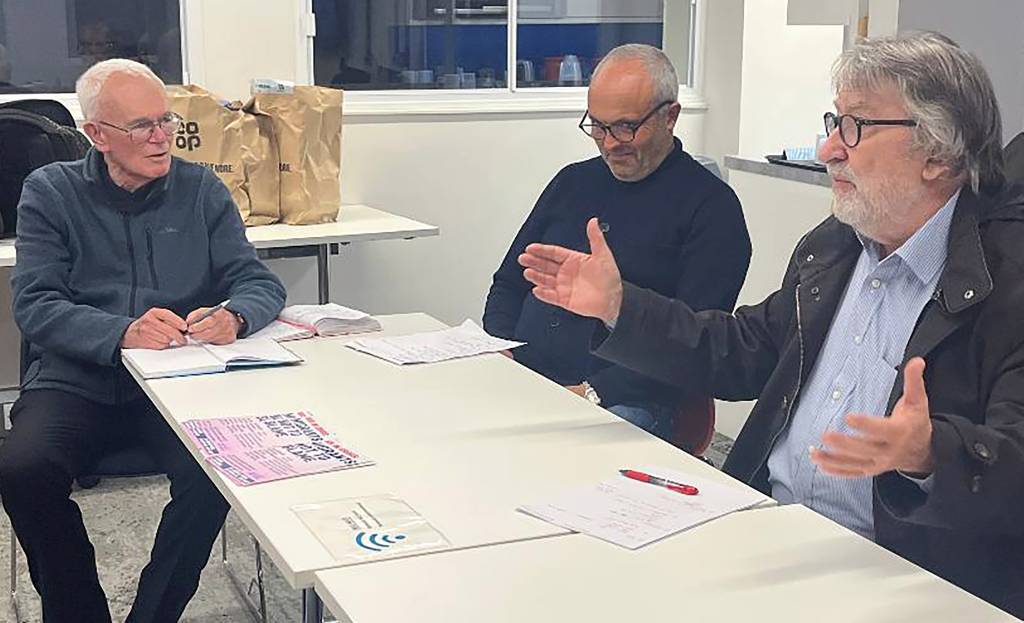
Branch Treasurer Phil Sutcliffe with Ion Tsakalis and Eric Longley
Eric commented on then-current speculation about the Chancellor of the Exchequer: “I'm very disappointed with Rachel from Accounts, because she had the chance to get rid of the 'non-doms' tax dodge and she didn't, it's just been slightly altered.
“When she got into office, she knew she had to get some more money. So she asked the civil servants: what have you got? And she chose the winter fuel allowance. Then she chose to attack benefits. So my constant cry, as a Labour Party member to my Labour MP, is: 'You're not listening to the Labour Party. You're not listening to Labour supporters. You're not listening to the working people of this country. There is more money out there'.”
That money is offshore. “There are those who get a paltry £250,000 salary plus dividends and live offshore.” It's a legal tax dodge.
“There's nothing wrong with stuff that's legal,” said Eric. “What I find is that it is immoral: because the business is here in the UK and they won't help pay for things they should be paying for. If the UK government only said, as the Americans do to US citizens: no matter where you go, you pay our tax (and you get a credit for foreign tax paid).”
But what's new for us? They're Making Tax Digital. From 6 April 2026 if you're earning over £50,000, and the year after over £30,000, and the year after that over £20,000 – you have to report quarterly on your income. It means we all have to do more work.
Accountants will get more business, “but it's not good business. It's appalling that the professional associations have not resisted this,” said Eric. “Our big discussion at work at the moment is, for smaller clients, how do we make it less consuming of their time? How do we make it cheaper for them?”
Probably the thing we most wanted to know about, he thought, was deductions: money we spend on which we do not have to pay tax. “The rule is very simple.” You put all your gross income in and from that you deduct the expenses that are “wholly and exclusively” for the purposes of your trade.
You may say “I have to get a child-minder to look after my kids so I can go to work, so that's for the purposes of the trade. Isn't it?” No, Eric said: that payment is for the purpose of looking after the children. “The motive is to go to work, but the purpose of the payments to look after the children.”
One relevant court case was lost by a Recorder – a variety of judge – “who went down to Southampton every day from London to sit in court there. He claimed the cost of travel. A court said no, you can't have that: you're not doing it 'in the performance of your duties'. You are doing it to live in London and work in Southampton. You can't claim the cost of travel from home to a regular place of work.”
Do not forget to claim for your laptop and your phones – but not for the portion of their cost that is for private use.
Expenses while you're out are generally covered by a tax case called Caillebotte v Quinn. Quinn was a carpenter and claimed the extra cost of getting lunch at work sites. The judge said: “you've got to live anyway.” Lunch is not for the purpose of trade, it's for the purpose of living.
‘When I think about their long-term prospects...’
Ion Tsakalis advises clients on their investments, their retirement planning: “I've done that 30 years”.
He has “two sons who are 18 and 20. When I think about their long-term prospects... I don't think there are any easy answers at the moment. You can see that now property markets have stagnated. I thought we would see more initiatives for growth” from government,
We are, Ion noted, “in a period where we've had a massive inflation of assets for a long time. People have been talking about inflation for three or four years because of the things that we pay every month, like our shopping and utility bills. But actually, we've had massive inflation since at least 2008: in terms of property going up, a lot of very wealthy people have got even wealthier.”
Since 2000 governments worldwide “have just created money and given it to banks. I suppose it reached its peak during lockdown with furlough, with bounce back loans and all.”
But it had to come to an end. “We're now reaping the result in terms of higher inflation and higher taxation. It's all coming home to roost.”
What about keeping savings in cash? “Especially if you're a freelance, you've got to have some money for emergencies. You get periods where cash can be a good long-term proposition. But at the moment we're in a period where you've got relatively high inflation and it's probably going to stay that way for some time.”
You need to be thinking about how much you set aside for longer-term investing. “Certainly we want something that will grow at a rate faster than inflation over the longer term. That could be property; it could be shares,” Ion suggested.
“If I were investing for the long term, I would be thinking about shares, because that's where you are going to get the long-term growth. I've been thinking long and hard about where I'm invested. My heart says to invest in the UK because I'm a UK citizen. But I feel that at the moment the UK economy faces an awful lot of threats, so I don't know. I'd probably have some more money outside the UK.”
Some older people may be thinking of accessing their pension funds “to buy an annuity or something... It's not an area where you can expect the property market to get us out of gaol in the long term.”
You've got to be saving – “from as young an age as possible. Do that as efficiently as possible and use your ISA allowances and use pensions. A pension stacks up as a very tax-efficient way to save.”
Questions
In response to a member, Eric reminded us that when we have money in a bank, and it is a UK bank covered by the Financial Services Compensation Scheme, the government guarantees your first £85,000 in any banking group. Note, though, that “sometimes you have four or five banks all in one group.”
What if you have just started? You need to register with HMRC at the latest by 5 October – six months after the start of the tax year on 6 April. Eric reminded us that in your first year “you can claim what's called pre-trading expenditure. So you spend three months putting the business together, buying a laptop, going around: claim that expenditure pre trading.”
A member asked about reviewing hotels: “While I prefer to review anonymously, most of the time it's done with the knowledge of the hotel, which provides a room and sometimes dinner.” Is that taxable? Eric does not think it is “payment in kind... I think that's part of the job.” By analogy, “you go to the theatre to review it. You got in free. It's not a benefit. It's for the purposes of your trade.”
Eric observed that “It's a privilege to pay tax. It means you're earning money. It also means you're helping other people.”
On the spot the Chair invited Eric and Ion to our planned “making freelancing pay” event in the Spring, and Eric accepted.