![[Freelance]](../gif/fl3H.png)
Gaza: the mirror in which every government’s hypocrisy is reflected
ON SUNDAY 2 November London Freelance Branch held a symposium in partnership with King’s College London’s University College Union branch to mark the annual UNESCO day calling for an end to impunity for crimes against journalists. For an overview of the event see here.
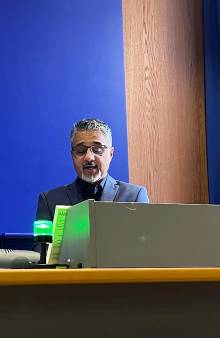
Tayab Ali speaks
THE FIRST speaker of the two-panel symposium was Tayab Ali, of Bindmans solicitors and founder of the International Centre of Justice for Palestinians (ICJP). Tayab has also successfully defended LFB members targeted by the UK Government weaponising anti-terror legislation against their reporting.
Tayab Ali: Thank you very much, Pennie, and thank you all for attending today and for the NUJ and King's College for marking this day with this event.
We gather here not just to remember foreign journalists, but to confront a truth.
A truth that should shame every government that claims to defend freedom: that the people that we rely on to tell the truth are being hunted for doing so.
And in most cases, very unfortunately, in most cases, their killers will never, ever face justice.
Over 1600 journalists have been killed since 2006.
Almost nine out of ten of those killings remain unsolved. That's not a failure of justice. It's the architecture of impunity which mirrors the architecture that's eroding any concept of international law and domestic law being applied fairly and equally to protect civilians.
Because when power is threatened by truth, it doesn't censor. It kills.
And, as a lawyer, I'd like to start with the law.
At least on paper, journalists are among the most protected professionals in the world. Or they're supposed to be. Article 19 of the Universal Declaration of Human Rights guarantees the right to seek, receive, and impart information.
Article 79 of the first Additional Protocol to the Geneva Conventions recognises journalists in armed conflicts as civilians, explicitly protected from attack.
Under the Rome Statute of the International Criminal Court the deliberate targeting of civilians, including journalists, is a war crime.
There are entire international mechanisms dedicated to journalists' safety: the UN plan of action on the safety of journalists; regional human rights courts such as the European Court of Human Rights and the Inter-American Court of Human Rights; and even the International Criminal Court's jurisdiction over attacks on civilians.
So the question isn't whether journalists are protected in law. The question is why, in practice, those laws fail so completely.
And the answer is easy: it's political.
Every instrument I've mentioned depends on the co-operation of states, and too often it's those very states that are responsible for the attacks. Law without political will is simple performance, and performance is something that we have perfected.
We issue statements, establish inquiries, express grave concern. Meanwhile, the people holding the camera, the notebook, or the microphone keep being murdered.
Nowhere is that more evident than in Gaza. Since October 2023, Gaza has become the deadliest place on earth for a journalist.
The Committee to Protect Journalists has recorded more than 190 journalists killed, nearly all of them Palestinian. Some estimates reach over 300. They were clearly marked or known as members of the press. They were civilians protected under international law. They were targeted and killed anyway. Entire media offices destroyed, families of reporters killed in their homes, children killed alongside parents whose only weapon was a camera. This wasn't in the “fog of war”: this is a pattern, deliberate, sustained and systemic.
It fits precisely within Article 8 of the Rome Statute, [prohibiting] the intentional targeting of civilians and civilian objects. It meets the definition of a war crime. And the world knows it, but knowing is not the same as acting.
Before this current escalation in Gaza, there was Shireen Abu Akleh, a Palestinian-American journalist shot in the neck by an Israeli sniper on 11 May 2022, while wearing a blue vest clearly marked “press”. Multiple independent investigations by the United Nations, CNN, the New York Times and others concluded she was deliberately targeted. Our own investigation at the International Centre of Justice for Palestinians (ICJP) concluded that she was purposefully targeted.
There was propaganda and cover provided to her killers from Israel, but also from the USA, which initially denied that she was killed by an Israeli sniper, only to have to [partially] accept it when the evidence and the noise became overwhelming. But three years on, there has not been a single prosecution, not even a formal apology.
That impunity set the precedent for what we see now. If you can murder one journalist in daylight and suffer no consequence, why not 200 under the so-called fog of war?
Why not just label a journalist a terrorist, and proceed to eliminate them?
Gaza is not an anomaly. It is the mirror in which every government's hypocrisy is reflected: from Mexico to the Philippines; from Russia to India; from Egypt to Brazil; the same story plays out: Journalists are branded as enemies of the state, foreign agents, or terrorists, they are detained, they are tortured, exiled, or simply disappeared and this contagion has reached our democracies.
Here in the UK, the assault is quieter and therefore, some might argue, more dangerous. We've seen journalists detained under terrorism and national security laws, some of whom I've represented directly; journalists stopped at airports, interrogated, their devices seized and their sources exposed.
The case of David Miranda, detained at Heathrow [in 2013] for carrying encrypted journalistic material, should have been a national scandal - instead, it became a precedent.
Now, the National Security Act 2023 expands those powers even further. It criminalises the receiving of information from foreign sources if deemed contrary to the interests of the state. Its language is so vague that almost any form of investigative reporting could fall within it if the authorities so choose.
It's not security, is it? That's censorship with a legal front.
When the law turns against those who hold power to account, the rule of law collapses inwards. And make no mistake, authoritarian regimes study this. When Britain justifies surveillance of journalists in the name of national security, others take note and follow suit.
But I do want to be honest about something really important. The threat does not only come from governments; it comes from within the media itself.
Many journalists today face as much danger from their employers as from the state. When editors spike stories to please donors or their owners, when executives bend to political pressure, when “objectivity” becomes a euphemism for cowardice, truth dies.
We've entered the age of client journalism, when some reporters – some reporters – no longer serve the public, but their sponsors, their advertisers, or even the governments, or even lobby groups.
And here lies the most dangerous cycle of all. When journalism becomes biased or captured, public trust collapses and when the public stops trusting journalists, the moral and political will to protect them disappears.
That's how impunity takes hold, not just with bombs and bullets, but with betrayal inside the newsroom. Media organisations must recognise they have legal and moral obligations to guarantee editorial independence; to protect journalists from retaliation; and to defend their right to report freely, even when the story is uncomfortable or the pressure is unbearable – because freedom of the press cannot survive on the courage of individual journalists alone. It requires institutions willing to stand behind you.
So, what must change?
Protection without accountability is meaningless.
- We need domestic laws that explicitly criminalise attacks on journalists as crimes against the public interest, and independent investigatory bodies with power to prosecute when states refuse.
- Universal jurisdiction for crimes against journalists, because when justice fails, it must be sought abroad.
- International sanctions on states that systematically target the press.
- And meaningful funding for a protection mechanism.
- Safe channels for whistleblowers, relocation programmes, and digital security support for those under threat.
- And just as important, we need a culture that values truth more than access, because if truth becomes partisan, there will be no law strong enough to defend it.
Every journalist killed, detained, or tortured is a warning that democracy can die not with a coup, but with a cover story. When journalists are silenced, atrocities go unseen. When the press becomes a threat, justice becomes a target and when truth itself becomes dangerous, law becomes a lie.
The protection of journalists is not charity. It's self-defence for our civilisation.
So, we honour Shireen Abu Akleh; the journalists of Gaza, the many journalists of Gaza; Dom Phillips and Bruno Pereira, and the hundreds and hundreds of others whose names we may never know.
Let's make one commitment: the next time a government kills a journalist, or a newsroom kills a story, silence will not be our response because without journalism, there is no justice, and without justice, there is no peace.
 No to impunity our symposium to mark the UNESCO day