![[Freelance]](../gif/fl3H.png)
No to impunity
ON SUNDAY 2 November London Freelance Branch held a symposium in partnership with King’s College London’s University College Union branch to mark the annual UNESCO day calling for an end to impunity for crimes against journalists.
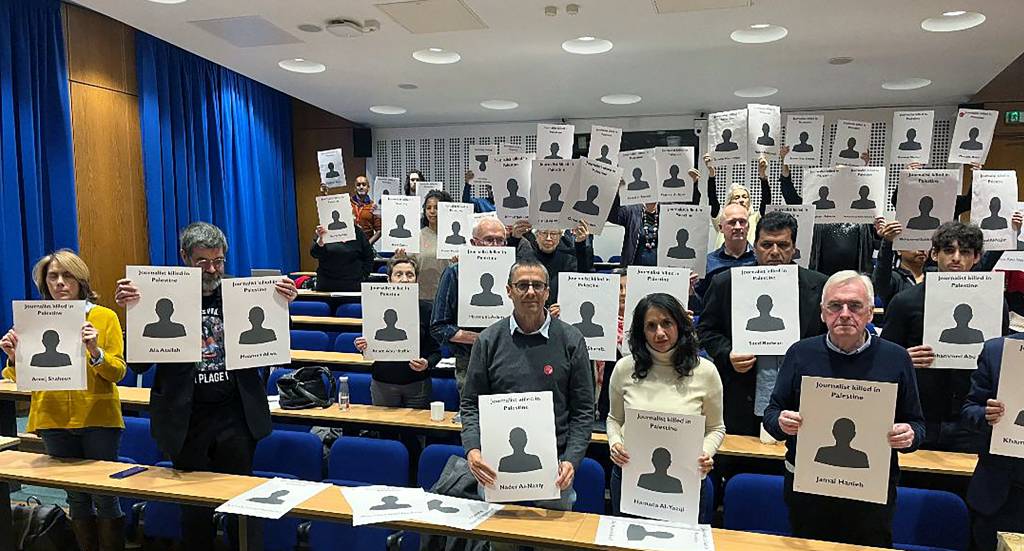
Closing the event on 2 November, we held up the names of colleagues killed in Gaza
THE FIRST speaker of the two-panel symposium was Tayab Ali, of Bindmans solicitors and founder of the International Centre of Justice for Palestinians.
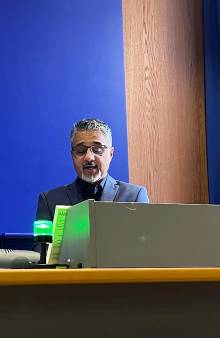
Tayab Ali
Tayab pointed out that “Gaza is not an anomaly but is the mirror in which every government’s hypocrisy is reflected. From Mexico to the Philippines; from Russia to India; from Egypt to Brazil,” he said, “the same story plays out; journalists are branded as enemies of the state, foreign agents, or terrorists, they are detained, they are tortured, exiled, or simply disappeared and this contagion has reached our democracies’.
Tayab proposed measures to end impunity for crimes against journalists: “Protection without account- ability is meaningless.” Domestic legislation should explicitly criminalise attacks on journalists; independent investigatory bodies should have the power to prosecute when states refuse to do so. We need “universal jurisdiction”; when local justice fails it must be sought abroad.
International sanctions should be imposed on states that systematically target the press, with funding of a protection mechanism for journalists, with safe channels for whistle-blowers, relocation programmes, and digital security support. He concluded: “every journalist killed, detained, or tortured is a warning that democracy can die not with a coup, but with a cover story... When journalists are silenced, atrocities go unseen. When the press becomes a threat, justice becomes a target and when truth itself becomes dangerous, law becomes a lie. The protection of journalists is not charity: it’s self-defence for our civilisation.”
Grace Livingstone
Tayab was followed by LFB vice chair Grace Livingstone and freelance journalist Ali Rocha, the founder of Brazil Matters, in conversation about the killings of journalist Dom Phillips and indigenous rights campaigner Bruno Pereira, who were murdered on assignment in the Brazilian Amazon in 2022.
Ali pointed out that because Dom was foreign more was done to find his killers while other journalists in the region remain at serious risk from criminal gangs operating in the Amazon.
Grace also outlined hazards faced by local journalists in Latin America - before Israel's onslaught on Gaza and on Palestinian journalists, one of the most dangerous places in the world for journalists, particularly with the killings of journalists in Mexico and Colombia.
 Journalists under threat in Latin America Grace Livingstone and Ali Rocha
On panel two we heard from John McDonnell, MP for Hayes and Harlington, in his capacity as secretary of the NUJ parliamentary group; broadcaster Sangita Myska; Neve Gordon, professor of human rights at Queen Mary law department; and Dr Moosa Qureshi of Health Workers for Palestine.
Branch Chair Pennie Quinton opened the panel by asking the panelists to respond to 10 Downing Street’s response to our letter demanding meaningful action after Israel’s targeted killing of the two Al Jazeera teams and freelances reporting from the Nasser and al Shifa Hospitals in August 2025.
Sangita Myska
Sangita Myska said: “whoever wrote that response really needs to go back to PR school, because from a journalistic perspective, that was just one dead cat thrown out after another… so what we’re talking about here is the deliberate targeting of journalists during what has been a catastrophic conflict for Palestinian civilians.
“Of course, journalists are considered civilians under international law, and that’s why we have the same protections as every other civilian. What we’ve seen over the last few years, of course, is the Israeli government act with complete impunity and essentially the slow, un-resisted breakdown of every international framework we have had in the world since the establishment of the Geneva conventions post-World War II, with literally no one doing anything about it.
“It’s extraordinary to me that our government chose to refer to Hezbollah and Hamas, and that is not what we were talking about.”
This government is as guilty as any other Sangita Myska
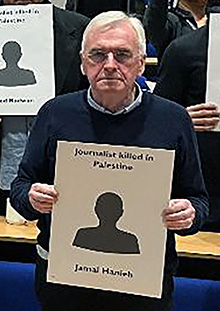
John McDonnell
John McDonnell said that as a union we can continue the pressure through the parliamentary group. “I think many senior politicians are hoping this will just go away now some peace deal has been signed… I don’t think the union will allow it to go away.
“We’ve seen the Israeli president come here, cabinet members photographed smiling next to the Israeli ambassador, who refuses to recognise even the two-state solution…
“The more they maintain that relationship, the more they can be accused of complicity. The government is vulnerable on this, politically, legally, and morally.”
The UK government is vulnerable John McDonnell

Neve Gordon
Professor Neve Gordon discussed the delegitimisation of Palestinian journalists’ reporting in Gaza. He listed Israeli journalists who called for the complete eradication of Palestinians from Gaza. Particularly chilling were the words of Roy Sharon, a correspondent on Israel’s Channel 11, who Neve quoted as saying: “I said that in order to finally eliminate the military capabilities of Hamas… we need a million bodies. Then let there be a million bodies.” “Such statements,” said Neve, “amount to direct and public incitement to commit genocide, an act punishable under Article III of the 1951 Convention on the Prevention and Punishment of the Genocide. Article 25 of the 1998 Rome Statute provides that a person who directly and publicly incites others to commit genocide bears individual criminal responsibility.” Neve referenced the Nuremberg trial of Julius Streicher, found guilty of inciting the extermination of Jews in his newspaper Der Stürmer and events in 2003 when the International Criminal Tribunal for Rwanda convicted three media leaders for direct and public incitement to commit genocide.
He continued: “Despite Israel’s attempt to cast Palestinian journalists as inciters to violence… it is time for each and every signatory to the Geneva Conventions and the Genocide Convention to ensure that those journalists and their media managers inciting genocide are held accountable by arresting them when they travel abroad, prosecuting them in national courts which have universal jurisdiction. What we have seen instead is numerous media outlets undermining the credibility of those who bear witness to Israel’s crime, while at times also facilitating the transformation of journalism into a vehicle that aids and abets genocide and crimes against humanity.”
Israel’s slaughter of journalists can’t go unpunished Professor Neve Gordon

Moosa Qureshi
Moosa Qureshi described how the barring of foreign journalists from Gaza has led top surgeons such as Nick Maynard, Khaled Dawas and Victoria Rose to adopt a reporting role – as the few foreigners being allowed into Gaza. That presented them with a stark ethical choice: to remain silent to be able to continue to deliver life-saving surgery, or to speak out.
Nick Maynard had worked in Palestine for many years and has numerous close friends in Gaza. Although he knew Israel would bar him from re-entering Gaza, he spoke to the UK Prime Minister and Foreign Secretary, at the United Nations, to US Senators and to senior White House officials. Dr Ghassan Abu Sitta, one of the world’s leading experts on traumatic war injuries, decided to act as a truth teller and was arrested when he attempted to travel to Germany.
Medical workers too are truth-tellers Dr. Moosa Qureshi
Please read the full contributions from each of our excellent panellists, linked above. Their work demonstrates that the world is facing a crisis of accountability for crimes committed against civilians in war – and that journalists, though they are also civilians, are targets because of their ability to report and document the actions that get politicians like Milošević and soldiers like Mladic in the former Yugoslavia prosecuted at the International Criminal Court.
- LFB thanks Dr Pete Chonka and Dr Ashwin Mathew of the Global Digital Cultures Research Group at King’s College London for partnering with LFB to mark the UNESCO day and for the courage of KCL UCU branch in balloting its members on local industrial action over academic free speech and the right of academics to refuse to take part in research activities or teaching that could make them complicit in war crimes.
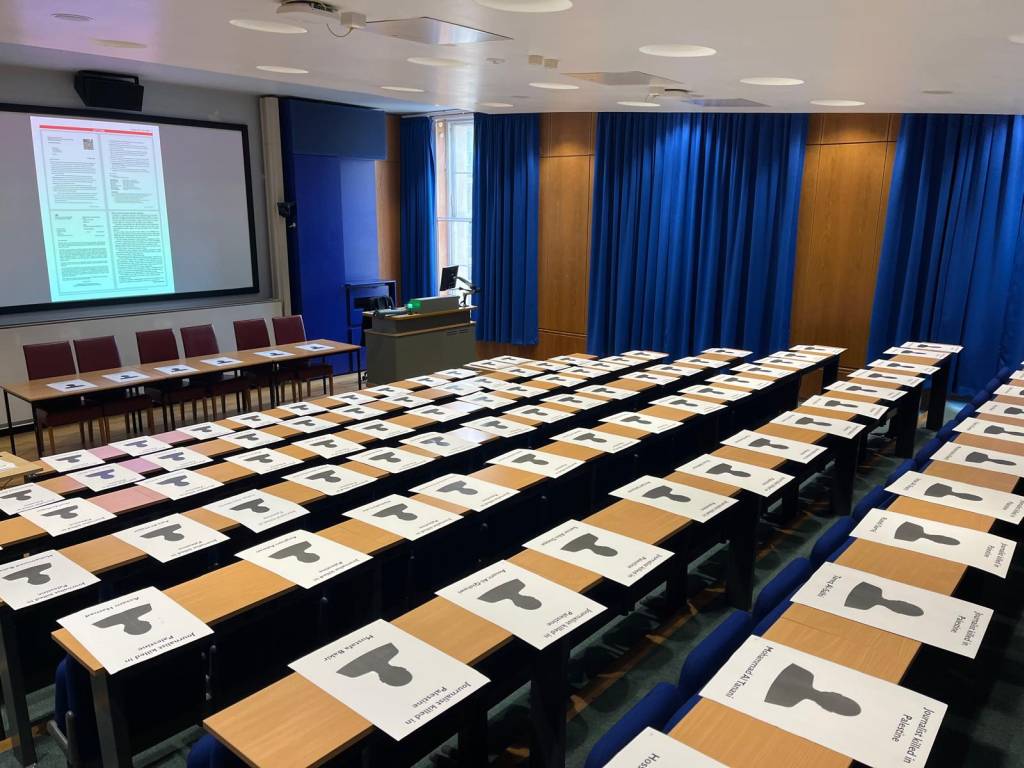
It would take three more of the lecture theatre where we gathered on 2 November - which holds 90 - to seat the colleagues killed in Gaza since 7 October 2023