![[Freelance]](../gif/fl3H.png)
So what is a ‘personality right’ and how could it go wrong?
PERHAPS you are a performer on stage or screen. If not, please imagine. You discover that so-called “generative AI” has “learned” the look and sound of your performances and is churning out fakes. What are your rights? The answer is unclear at the moment and leads to questions such as: have you trademarked yourself? Can you afford a trademark lawsuit if so?
A widely-proposed solution is a “personality right” - like copyright, but for people. The name makes deeper sense in the original French: « droit de personalité ». This could be an answer to performers' needs; and if not done right it poses a risk for journalism.
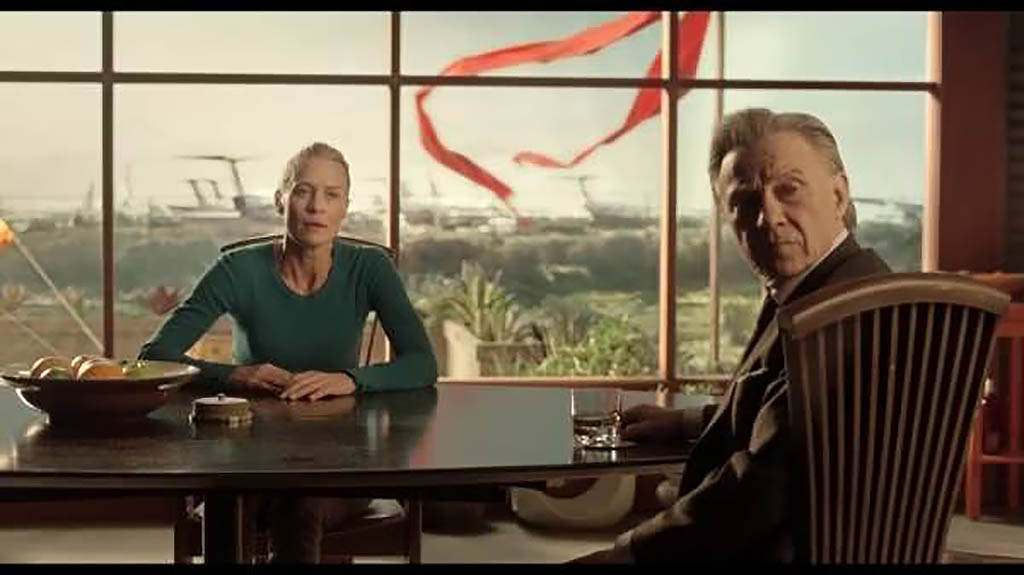
Robin Wright, sort-of playing herself, discusses the proposed assignment of her self with agent Al (Harvey Keitel) in The Congress
We have been warned. In the under-appreciated 2013 film The Congress, loosely based on Stanisław Lem's outstanding 1971 short novel The Futurological Congress, mature actor Robin Wright is presented with a stark choice: she will agree to be scanned and sign over all rights in her self to Miramount Studios, which will endlessly reproduce her for no fee; or she will never work again.
It all gets very weird - which will be no surprise if you have ever read any of Stanisław Lem's work. It prefigures the 2019 Facebook metaverse (see digression). The world outside the virtual reality is bleak and ruled from the skies by a tiny authoritarian élite.
A personality right won't fix the aerial élite part. But, as proposed in the US, it would grant an individual the right to authorise (or not authorise) the use of their voice or visual likeness in a digital replica. The No Fakes Act - laboriously standing for “Nature Originals, Foster Art, and Keep Entertainment Safe Act” - was introduced into Congress on 20 May by Representatives and Senators from both parties.
In the current state of the proposal the right would not be assignable during the life of the individual. It could be licensed for up to 10 years; the Freelance is expecting music and film companies to demand this, but notes that the right would not be able to be licensed where there was a collective bargaining agreement covering these matters. The right may last for 70 years after the individual's death - but only if someone registers with the US Copyright Office.
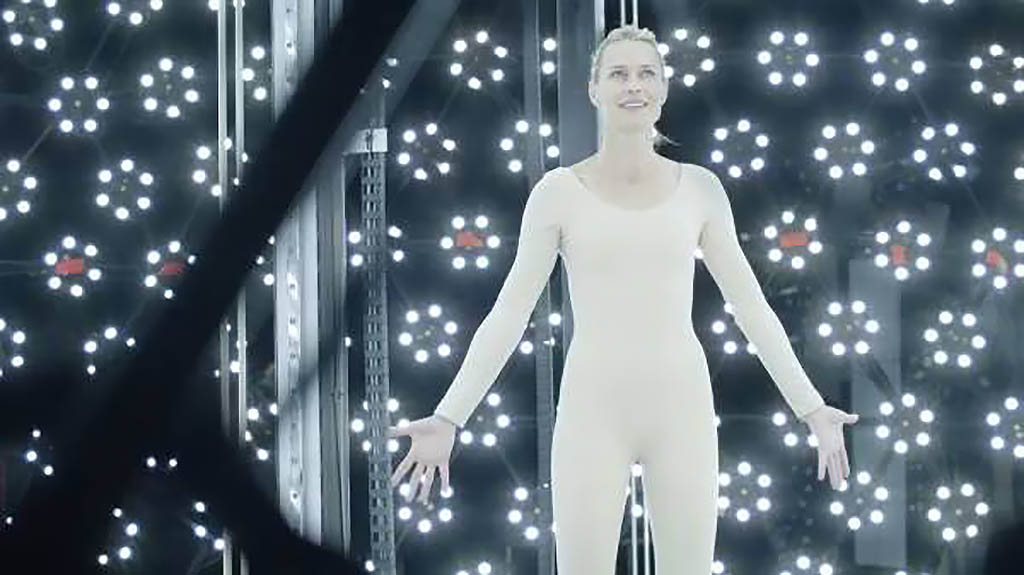
Robin Wright is scanned in The Congress
The right would be enforced by suing in the civil courts - and there is provision for ”takedown notices”, and for appeal of these. Statutory damages are set at $5000 against individuals and (broadly) $25,000 against companies - or the actual damages if provably greater. Legal expenses could be claimed on top.
So what could go wrong? As the Freelance put it in March we should worry about any law that might allow suppression of a photo of a politician emerging from a crack den at 3am on the grounds of a right in their identity or image.
We are thus left in the slightly awkward position of arguing that there must be a strong “exception” to a right that would benefit our performer colleagues.
There is a specific exception in the US proposal as it stands allowing distribution by a “bona fide news, public affairs, or sports broadcast or account, provided that the digital replica is the subject of, or is materially relevant to, the subject of that broadcast or account”. Additionally, a “digital replica” is defined as one “in which the actual individual did not actually perform or appear”.
So our fears seem to be dealt with in the current state of the proposal - though such wording cannot absolutely prevent hopeless cases brought in bad faith as strategic lawsuits against public participation (SLAPPS). Measures to stem these are more urgent than ever.
Something in the state of Denmark
It seems that an amendment to the law of Denmark was due to come into force on 31 March, also giving people a right adjacent to copyright in their image. We do not yet have more concrete detail, though we note dissent both on the grounds that a right that can be traded dilutes the purity of a personality right and from an organisaton whose purpose is to argue that copyright is bad.
7 July 2026 The draft of the Danish legislation indeed said (according to Google Translate) that “Lifelike digitally generated imitations of a performing artist or artist's artistic performance may not be made available to the public without the consent of the performing artist or artist. The protection... shall last until 50 years have elapsed after the year of the death of the performing artist or artist.” Similarly but separately, “realistic digitally generated imitations of a natural person's personal, physical characteristics may not be made available to the public without the consent of the person imitated”, with exceptions for “caricature, satire, parody, pastiche, criticism of power, criticism of society, etc... unless the imitation constitutes misinformation that can specifically cause serious danger to the rights or essential interests of others”.
We see no special clauses on enforcement in the Danish text, so those for breach of copyright would apply; and, we hope, exceptions protecting news reporting would equally apply.
As ever, we need to be keeping an eye on all this, and especially on hostile amendments in the US...
 No Fakes Act tracker at govinfo.gov
'Artificial Intelligence' our coverage to date
No Fakes Act tracker at govinfo.gov
'Artificial Intelligence' our coverage to date
Digression
Meta Inc, owner of Facebook and WhatsApp and so forth, announced in December cuts to the metaverse project and in March the closure of its Horizon Worlds virtual reality component on 15 June. At the time of writing Meta still announced, however, that “we believe in the future of connection in the metaverse.”