![[Freelance]](../gif/fl3H.png)
ʻNo means no’: freelances push back on ʻAI’
Our 8 June meeting in the House of Commons
THE LONDON Freelance Branch parliamentary meeting on 8 June was kindly sponsored by John McDonnell, secretary of the NUJ Parliamentary group. The meeting hosted a powerful line-up of media experts to discuss the impact of AI on Journalists and journalism.
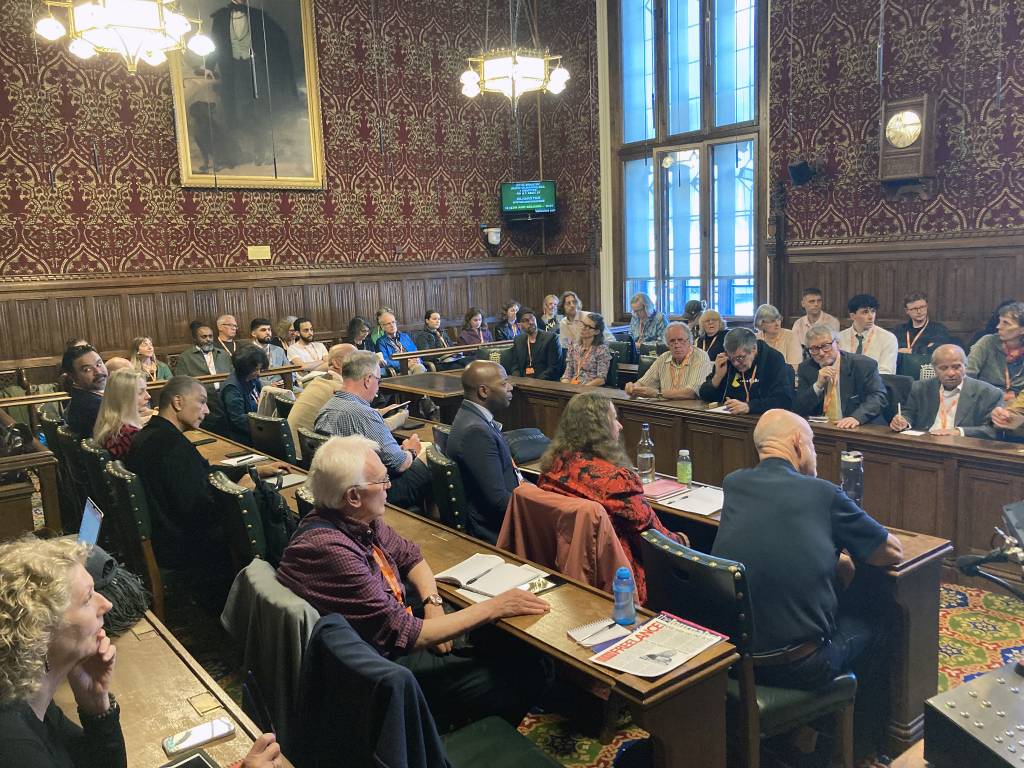
Committee Room 12 was packed
Organised and facilitated by branch chair Pennie Quinton, we heard from NUJ General Secretary Laura Davison; the director of the Digital Futures Institute at King’s College London, Professor Kate Devlin; and the CEO of the Association of Photographers (AoP), Isabelle Doran, also a vice chair of the Creators’ Rights Alliance (CRA). Our host, John McDonnell MP responded to the panellists after they presented.
At the start John McDonnell said: “before we leave this room, we need clarity about what the strategy is, about how we’re going to get the legislation we need. Alongside the discussion in the NUJ parliamentary group, we’ve been turning up at the various debates, including Westminster Hall debates, for a year or two.
“We’re not getting very far in terms of firm legislative commitments. The TUC has brought out its proposals on legislation. From the NUJ perspective, how do we refine that and take it forward? I’d like at some stage, when people are finished, to have that discussion about strategy.”
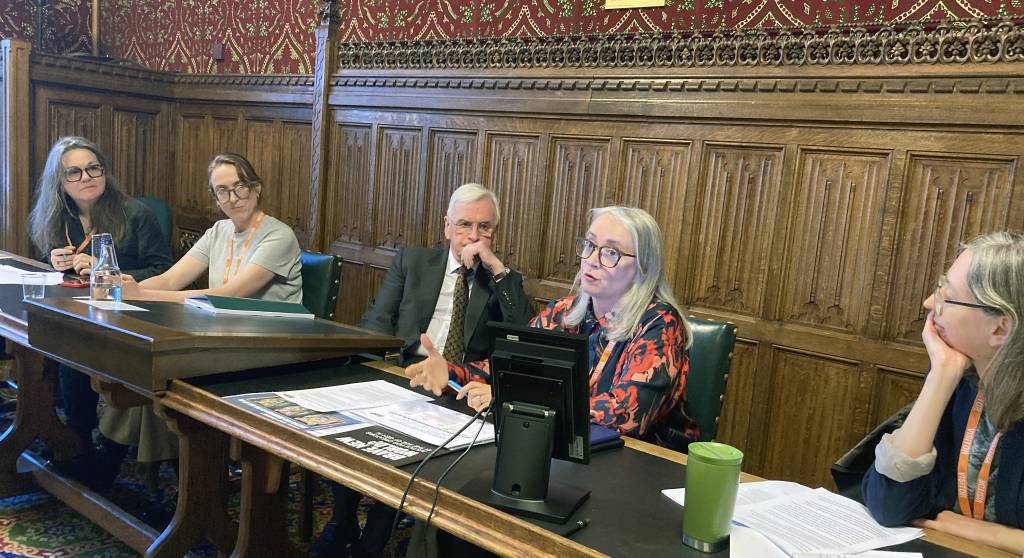
Isabelle Doran speaking
Isabelle Doran, CEO of the Association of Photographers
Isabelle Doran introduced the report Brave New World? Justice for Creators in the Age of AI, by a coalition of collecting societies, creators’ advocacy organisations and trades unions, published in January 2026. The five organisations involved in the report were: the Society of Authors; the Association of Illustrators; the Independent Society of Musicians; the Association of Photographers; and Equity, the actors’ union.
Isabelle told us that the report was “a gathering of the surveys that we’ve been doing for a number of years. It was important that we pulled this report together because we knew that the government was going to be publishing its report on 18 March 2026. As a result of the pressure that was placed on the government for the Data Use and Access Bill when we saw a huge amount of Lords – including the ʻCreators’ Champion’ Baroness Beeban Kidron – lobbying the government to make sure that there was clear legislation that supported creators’ rights… Obviously that didn’t succeed. However, the government made a legislative promise to deliver an economic report.”
Isabelle noted that “we were concerned about what that report might contain; we felt it was important to show not just parliamentarians, but governments and other parties interested, what impact generative AI has had on the creative industries, particularly on creators and performers.”
The impact of ʻagentic AI’ on photographers’ incomes
An AoP survey found that 99 per cent of all members had their work scraped online… “But specifically for photographers and photojournalists: the Association of Photographers has 3000 members. They’re all high-end professional photographers and have an average turnover, obviously this isn’t profits that they make, but their turnover is £117,000 because they’re dealing with equipment and large photo shoots.
“The unofficial Office of National Statistics (ONS) figures say there are about 50,000 professional photographers in the UK. We had to extract from that, because within TV, radio and film, photography is nestled in there – that’s why it’s unofficial – but there are a lot of photographers out there.
“The report references the survey from 2025. We felt it was important to do another survey in 2026 with our members. The findings were pretty stark. The 2025 report found that 58 per cent of our members had lost commissioned work to generative AI. That’s a huge amount of work that has been lost. That is the same result that we got in 2026.
“OK: why is that? Where there was a difference is that the average loss in turnover jumped from £14,000 in 2025 to £35,000 in 2026… We suggest that it is a value transfer: money is going from photographers to generative AI.
“I think that’s very, very clear. But also, importantly, what we saw with the photographers licensing their images themselves – our members tend to do that a lot because they’re commissioned directly – there was a 65 per cent drop in being able to license their work.
“Again, this is staggering… It shows the significant impact of generative AI on creative livelihoods… most of it is because their images are being scraped online. And there’s very little you can do about that… and 98 per cent of our members wanted to be compensated for past infringements by AI companies…
“We still haven’t seen a key, clear decision by government. What has happened is that [AI companies] are breaking the law and bringing products and services into our marketplace and not paying for the very materials that make these products. And of course they’ve made them extremely enticing.
“I personally have refrained from trying to use any AI program, because I prefer to do a bit of hard work and critical thinking. But it is very enticing. It is very simple and easy to use, but they’ve done it deliberately so that of course it is convenient, it is easy to do. All of this happens without the opportunity for us to be able to know what has gone into those programs we lack a huge amount of transparency…
“The other key thing is that not only do we want our creators to be compensated, but we also want transparency about which works have gone into these programs and how they’re being used… The first iteration of generative AI services was back in 2022, and we’re in 2026 and still nothing has been done and more programs, more services are coming out…
“In the UK it’s a lot harder to take a case to court because you need to prove that there has been an illegal act. Of course, we’re seeing overseas that there are at least 100 cases against AI developers… it does feel rather egregious that we still don’t have a decision made here.
“I also want to provide you, with a bit of context. [AoP] membership lost income: if I extrapolate across the whole membership, they lost £104 million… If that’s reflected across our sector, so where I mentioned that there were 50,000 professional photographers, that’s £1.745 billion. Now not all of them necessarily would be in the same category. Some are employees that work in fashion, and lots of different e-commerce businesses, but that just gives you some perspective, particularly when you compare it to the fact that within the creative industries there are nine sub-sectors and photography is sitting in one of them with film, TV and radio. That’s £21.2 billion that’s made every year.”
Taking that into account and considering the median average turnover across photography, which is about £38,000’, Isabelle then estimated the loss at a staggering £1.88 billion.
She told us: “Several photographers have said they haven’t worked in a year. One photographer said: ʻmy most iconic images have been compromised. Generative AI undermines my ability to control the use of my work and therefore my IP income is reduced to zero.’ Another said: ʻit’s hard to quantify fully... my business turnover is down over 60 per cent from last year to about £50,000 to £100,000’.”
Isabelle asked: ‘What are we to do when that happens? …it’s not a matter of simply retraining. Here we are in a room of journalists but you’re not going to suddenly retrain and do another job, – ... [You won’t be using] the new ʻAI Assistant’ that the government announced today for people looking for a new job.”
What we want
Generative AI is replacing workers to reduce costs and improve productivity. So “our legislative asks are really clear. We want statutory compensation for creators [whose work is] placed on overseas generative AI services. We want to see legislative transparency, such as traceability requirements to pursue copyright infringements in court.
“We’d like to see a personality right -- but obviously with a carve out for press reporting. And, importantly, we want labelling of generative AI, of synthetic image outputs… It’s important for the public to be able to be aware of whether images or text are AI generated.
“So, it’s not just affecting us. It’s affecting the general public as well… where you have a single work you should be able to have an AI label.” Isabelle clarified that this wouldn’t mean labelling individual video frames.
“Tim Flack, who is the president of the Association of Photographers and is extremely well known globally for his animal portraits, invests a huge amount of time and money into his works. So, for example, just to bring a tiger into a sort of studio effect costs about £10,000. Tim recently published a book called Feline: he invested his own money, £100,000. He makes money from selling his work overseas, he then invests back into his next projects.
“But generative AI has improved so much that after the iteration of a tool from version 5.2 to 7, you cannot tell the difference between the real tiger in Tim’s picture and an artificial, synthetic picture. All you have to do is type in the prompt ‘tiger by Tim Flack’ and it appears.
“This is the challenge that many of our photographers are facing. They can easily have their works replaced by generative AI… it’s right across the board and it’s really important that we support each other’s campaign and ensure that we encourage governments to listen to us.”
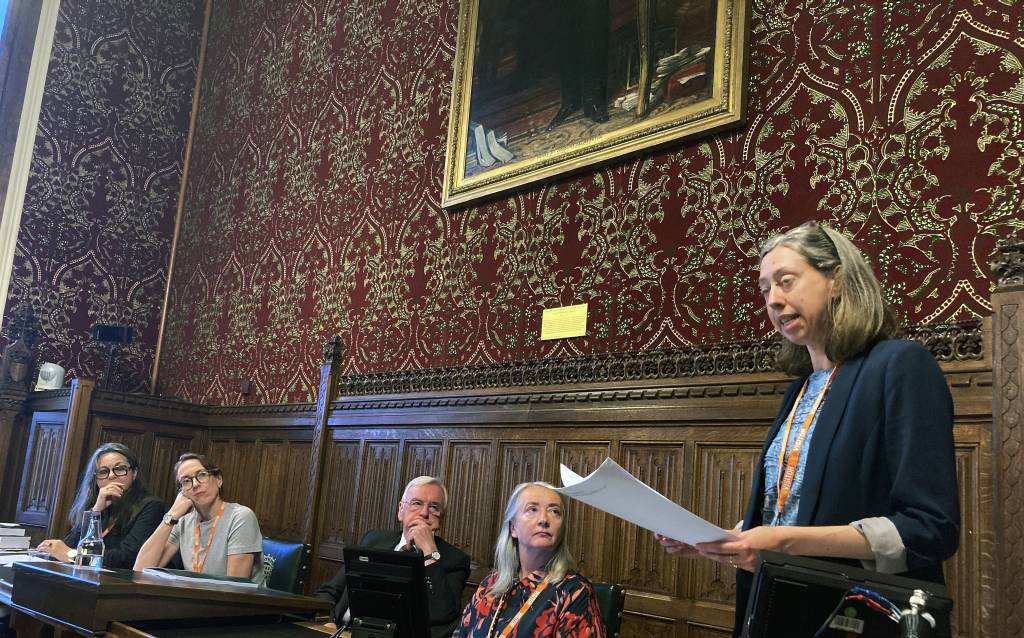
NUJ General Secretary Laura Davison speaking
NUJ General Secretary Laura Davison
NUJ General Secretary Laura Davison announced that “I want to talk about trade unions. That was a very sobering set of statistics that you gave, Isabelle, but hopefully that will also spur us on to the action that we need to take collectively and work together on.
“It’s our central role to navigate technological change and to make that change fair and equitable. Going back to basics, what do trades unions do?
“They bring workers together, they bring our voices together, and they know what they’re talking about because they’re rooted in the experience and the working lives of our members, and that is very powerful.
“At our best, trades unions are diverse, provide ways for members to support and talk to one another and learn from and link up with others fighting on the same issues here and around the world.
“Artificial intelligence is a cross-cutting, massive global change. It’s exposing, like all technological change, those who control it and those who don’t, those who have access and those who don’t.
“It’s demonstrating the power for tools to be used for human good – and for turbocharging abuse, sexism and mis- and disinformation.
“Many have already fallen foul of its mistakes, failing to make human checks, and have reaped the reputational damage. In our own sector, we’re seeing artificial intelligence rolling out in different ways. It’s not an abstract; it’s very present across the industry and is already affecting jobs, terms and conditions. It’s impacting economic models with the loss of the now old-fashioned ‘search’.
“Earlier this year, Newsquest stopped advertising for AI-assisted journalists. It was a recruitment strand that the publisher had launched in 2017, to employ reporters who would use AI to make them more productive. But the end of this programme has come not because Newsquest has done with AI, but because it’s so integrated now in their news-gathering that all reporters are expected to make it intrinsic in their work.
“The penetration of AI in journalism isn’t universal or evenly applied, but Newsquest is by no means the only publisher that boasts about what a difference AI has made to its work. Sky Sports, for example, uses AI to clip videos to create Instagram-style stories to publish on social media, goals and red card incidents, for example.
“The results are human-checked. From more than 200 games so far this year, Sky has generated 20 million views, with a fraction of the human effort that this would have taken a few years ago.
“In Birmingham, a Reach reporter is using an AI-enabled translation app to interview non-English-speaking residents of the city, interpreting her questions to them and their replies back to her. It’s taken local reporting into new communities.
“Data analysis has accelerated exponentially. It’s widely believed that the Epstein files would have taken far longer to unpack without AI interrogation.
“AI’s scrutiny of candidates in the last general election uncovered one candidate who had created his entire campaign with AI, including videos of encounters with AI-created members of the public. These changes are happening, so what can and what should we do?
“What should the priorities be for the NUJ in respect of controlling the impact of AI on journalism and ensuring that there’s not disadvantage or unnecessary pressure on journalists?
“The first is something that’s been intrinsic to the NUJ throughout our existence, and that’s the need to defend the ethical core of journalism.
“As well as speeding up research, facilitating communication and sorting data, AI can create and multiply falsehoods, undermining public trust in journalism, risking business models and the reputation of individual journalists… Accuracy and truthfulness, checked by human beings, must be at the core of journalism. That quality is what distinguishes us from the automated producers of AI slop.
‘AI must not be used as another way to cut costs, shrink newsrooms or consign freelances to poverty’
“We must continue to make brilliant human content and continue to advocate for the creativity of our members in all its forms. AI development must be subject to human oversight and to workers’ agreement.
“Exploitation and theft of our created content is simply wrong, and AI must not be used as another way to cut costs, shrink newsrooms or consign freelances to poverty.
“News platforms make much of the potential for AI to undertake routine tasks, thereby freeing up journalists to leave the office and get back to ‘proper reporting’.
“Over the past four or five decades, changing technology has had a huge impact in the way news products are created. But over that period, what have we seen in reality?
“The number of reporters has fallen relentlessly. Journalists getting out of the office has become rarer. Workloads have risen.
“If allowed to roll out unconsidered, without due regard to human imagination, AI will bring increased drudgery, more content demands, higher workloads and a fundamentally de-skilling experience, just at a time when we want to encourage more young people into our profession and support them.
“The best and simplest way to ensure that journalists themselves benefit from AI rollout and that journalism and journalists are safeguarded will be through industrial agreements. They are fast, they are responsive, they are familiar in a way that legislation and legal action are not.
“We have been grateful for guidance from our American sister unions who have made significant progress in this field and have been generous, along with the TUC and the International Federation of Journalists, in sharing their resources and successes.
“Later this week the NUJ’s new Copyright and Artificial Intelligence Committee (CAIC) will have its first meeting. Hopefully CAIC will be looking at ways to learn from and share good practice in our chapels where reps are actively engaged on these issues and applying lessons from elsewhere will be among the first of its tasks.
“We must ensure that this technological revolution really does benefit journalists and journalism and all of those who want to take advantage of that and protect one another in doing that.
“We must prevent a gulf opening up between journalists who use AI and those who don’t, particularly among freelances.
“It’s the union’s job to find ways to ensure access and benefit for everyone. Just as important is defending the copyright belonging to those journalists who still own their rights, mostly, again, freelances.
“We know a lot of the big news platforms have already reached deals with AI giants, though they’re not very transparent, to sell access to their archives, despite these not being solely owned by those news platforms.
“Defence through the courts is a developing area and one that our last delegate meeting asked us to consider. We’re also exploring with the Authors’ Licensing and Collecting Society other means of achieving a fair settlement for freelances in such circumstances, launching the initiative Scoop and exploring other licensing options at all times on the principle of an opt-in mechanism.
“The NUJ’s main campaign calls for an AI for public good. That include the deployment and regulation of AI based on principles of worker control, consent and compensation.
“We can’t do this on our own, which is why we appreciate being here tonight in a place where legislation can create change alongside John, our incredibly hard-working Parliamentary Group Secretary.
“We do need urgent government intervention through comprehensive legislation, regulatory oversight and enforcement of existing copyright law. We were relieved to see that the government no longer favours an ‘opt-out exception’ to copyright for artificial intelligence training, after a lot of campaigning effort by many colleagues in the room and others; but we need explicit support for a simple, revocable opt-in mechanism for individuals and as part of collective licensing.
“The majority of the public support transparent labelling of AI-generated journalism, whether it’s text, image, audio or video, that will help people assess the veracity of sources and improve public trust. And that needs to be an industry-wide regulatory requirement because employers are reluctant to take that step on their own.
“Tech companies should be obliged to disclose their training data, the design of their algorithms and their output, and pay their fair share for the wholesale robbery of creative workers’ labour.
“It’s incumbent on the government to hold to account tech platforms that have pillaged and profited from the media sector with impunity while facilitating the spread of disinformation and discrimination on their platforms and pushed by their algorithms.
“We’ve called for a 6 per cent windfall tax on the tech giants to reinvigorate the news sector as well as an ongoing digital tax to provide sustainable future funding and there is growing interest I think in this proposal, so this is something that we need to push further.
“We do support and we appreciate the support of parliamentarians and NUJ members in the next phase of this campaign.
“And there are many ways that our members can play an active role in our response to AI, standing up for ethics, fighting for collective agreements and engaging in workplaces, whether as a staff member or a freelance.
“One of the most important and straightforward things that any of us can do is to recruit new members to our union. If every person here recruited one person to our ranks every year, it would amplify our message and buttress our campaigning. If we all do that, then just, responsible and equitable technological change safeguarding the interests of journalists and journalism will be possible. And I hope that you will join me in fighting for that.”
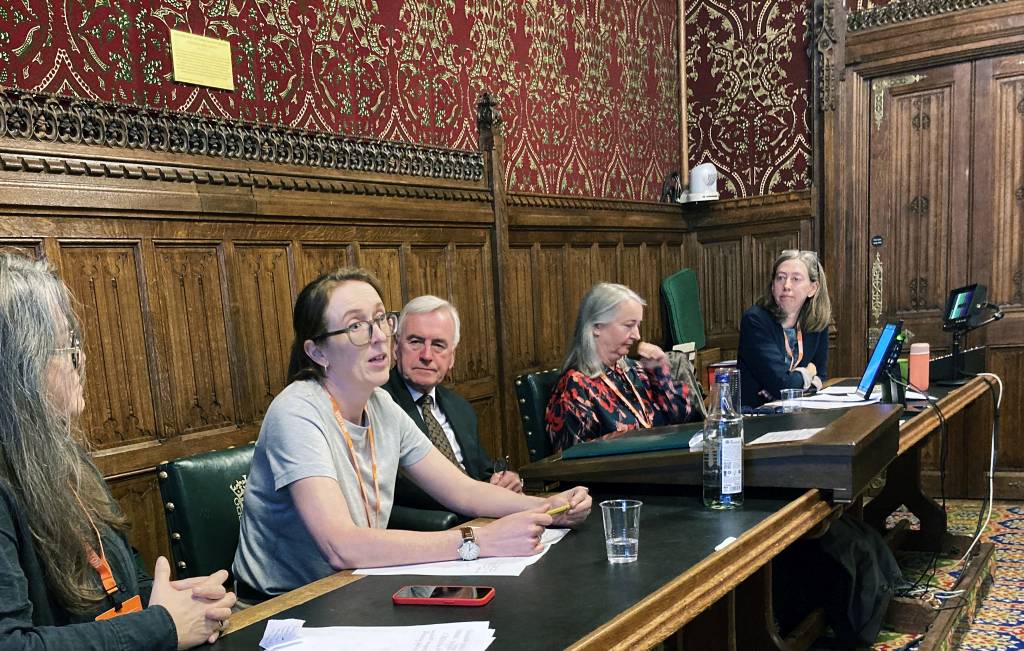
Professor Kate Devlin speaking
Professor Kate Devlin, head of Digital Futures, King’s College London
Professor Kate Devlin, the head of Digital Futures at King’s College London, spoke on information homogenisation, consent and popular push back against AI systems. “I’m an academic, I’m also a writer, I’m also married to a freelance journalist, so it’s hearts and minds for me and I’m absolutely invested in this.
“Within 16 months of ChatGPT being released in November 2022, it had reached almost all economies worldwide. It’s probably the most unprecedented uptake of technology that we’ve seen – and immediately the problems begin. We’ve just heard about some of those. My own work was stolen by Anthropic, and I have a share in the class action that’s going forward in the US.
“What I would like to talk about is a couple of things. First, one of the big problems we see with large language models is homogenisation of information; and we are losing information because of the way that these models are designed.
“They’re designed to fabricate. They’re designed to make things up. We shouldn’t be surprised when they get things wrong. It is their job to make things up.
“Further, they are all defaulting onto this Silicon Valley Western approach – so that when you start diving deeper, or ‘delving’ if you want to use the ChatGPT word of choice, when you start delving into this you find that they are returning very similar things and we are losing the ‘long tail’ of information.
‘As they converge and homogenise information, we lose plurality’
“For starters, these models are trained on human input. But a lot of human input hasn’t even reached the data set. So, there are vast numbers of people in the world who are being left out – not least those who don’t speak English, because the majority of these data sets are in English.
“As they converge and homogenise this information, we lose the plurality, we lose the viewpoints of others. This is a big problem in itself.
“One of the things that’s very interesting that we’re seeing is an increase in pushback; people are starting to say that they’ve had enough… more and more we are seeing signs of this with the public. Whether that is the graduations in the US where commencement speakers are being booed when they come from tech companies; whether it’s people actively calling out the use of AI slop on social media, refusing to engage when they see this content; or setting self-driving cars on fire in San Francisco, which may be like a little bit of a step too far. I’m not suggesting we do that yet.
“There is an increasing refusal to accept generative AI output. We’re also seeing a language change around AI.
“I have AI in my job title because AI used to mean things like machine learning and now AI is being taken to mean generative AI. So even the way we talk about AI, when people push back, they’re not pushing back specifically against a technology. It’s a whole ecosystem of things that they are starting to refuse.
“And refusal to use AI is often misunderstood as a very irrational fear or it’s seen as some kind of technological illiteracy, some kind of Luddite behaviour. But the Luddites had a point. [They addressed] very deep-seated concerns that people have about things like autonomy and equity and the unchecked power of tech systems.
“And people are pushing back, not just because they don’t want the technology or the output of the technology, but because they feel it’s the only form of control they have against systems that they see as being deeply unfair.
“And I think that AI comes down to a question of consent – and people are starting to reject it because they do not have control and they do not feel that they have given their consent to be part of something like this.
“Refusal is very contextual. We know that there are places where AI can be used and it may not receive the same pushback. It could be [used] in things like the film industry where parts of that may be streamlined and optimised. But it is contextual.
“We need to think about how rejection and resistance to AI informs regulation; and this comes back to the copyright issue as well.
“Where is our consent and where is our opt-out mechanism?
“By opt-out, I don’t mean the government opt-out [that Isabelle discussed]. I mean us opting out; because this is being baked into everything that we use. If you use a piece of software, you now have it hovering over you as you work and trying to engage with your e-mail or your word processing. It’s always there, always telling you, please use this. Sometimes we don’t want to. So, we’re seeing this shift from passive avoidance to active pushback.
“I think it’s interesting. John mentioned a revolution. Perhaps that’s what is happening now. We are seeing more and more pushback. We’re seeing CEOs finding that they are not getting the advances that they were promised.
“We’re seeing that companies are going to have to start charging for the use of AIs because the ʻtokens’ are expensive. AI companies are starting to say you must pay to access this stuff.
“It’s turning out that it’s cheaper to hire a junior developer than it is to pay for Claude to write your code.
“So, how will this transform the work landscape? It’s not playing out the way people thought it would. And I think in some ways that’s a positive for us where we can say: right, it’s not doing what you said it would, now is the time to take stock and think about how we can shape it so that humans are at the heart of this.
“How does this rejection inform regulation? How can we make sure that we have given our consent to the things that we want it to do?
“We’re doing some work on this. By the end of the month, we hope to have a report out specifically around these things: about how and why people are choosing to reject AI. But I think that the signs we are seeing right now are that it’s not just those who are being directly affected who are starting to have problems with it. It’s definitely becoming more and more of a social movement to push back against AI. And if you’ve talked to younger generations recently, they’re particularly intolerant of it.
“So, I think that’s kind of a note of hope as well; that all is not lost; that there are perspectives that this is not the brave future that we’re marching into. And I’d be quite interested if the government realised at some point that the thing they’re so excited about as being the most pro-innovation thing ever, not everyone’s happy about it.”
Pennie Quinton: “I note that young Quakers are organising a conference about the fact that AI is untruthful and how it lacks integrity and how they want to reject AI from their A-level exams. So, I think some young people are pushing back and refusing it.”
John McDonnell on industrial agreements, ʻAI’ and an Employment Rights Bill Mark 2
“On your point with regard to cars: I’m working with Unite cab drivers, because in London at the moment there’s experimentation taking place on driverless cars, causing all sorts of issues. In one of the experiments, one drove into an area which was the scene of a crime, and of course it didn’t recognise the tape and upset the police.
“It looks as though we could be in a situation where Transport for London, and some of the Transport for London board members are working with us on this; by the end of the year we could have pilots with driverless cabs. There are about 130,000 people who work in that sector and, again, there is a real concern among the public and others who need assistance – particularly physical assistance if you’re disabled – but also there’s general anxiety about whether or not it should go any further beyond these pilots...
“I agree that people must be protected but [they must] also be involved through industrial agreements. I agree with that completely.
“We’ve got John Hendy here who, people will know, is in the Lords nowh… He is our leading specialist on employment rights and the basis of the Employment Rights Act that’s gone through. That largely revolves around the work that he did on the use of employment rights, even though it didn’t go as far as John and I wanted it to. But we’re looking at an Employment Rights Bill Mark 2 that we can lobby the government over, and it’s beginning to pick up quite a lot of support you can see a number of unions as well.
“That might give us the opportunity of inserting into it some of the principles that you’ve set out.
“One of the key principles for me is ensuring there’s full transparency, not just about what’s happening at the moment, but also transparency about the development of new systems; that there’s proper consultation; and that there’s proper impact assessment and that impact assessment is about the impact upon employment and workers themselves, but worldwide as well. Because at the moment these things are creeping up on us, almost in the dark, and we don’t hear about them until they’re virtually imposed. And the issue I do come back to is the issue around copyright as well.
“This isn’t Luddism at all. Remember, these developments have been created by workers themselves, largely to ensure that actually we can get the benefits of new technology and as a result of that - enjoy the benefits, hopefully, in having less onerous work and reduced working hours, that sort of thing, and better rewards.
“So, this isn’t Luddism; what we’re seeing at the moment is theft. In reality it’s the theft of creative work and no one can tolerate that and I think it’s another form of deepened exploitation that we’ve got to confront.
“So, I think the way to do it is to have legislation that sets out the basic principles; then you can use those principles in the industrial relations strategy, in the negotiations.
“About 18 months ago I was involved in Equity’s campaign in support of what the strike in America. The same themes that came out then were that the various writers, producers, and so on were all heavily engaged in the development of new technology to enhance their skills and to enhance what they produced. And we’re welcoming some of it, but the basic principle was that we want an element of control and we do not want this to be used to exploit us even further and we don’t want it used to be ripped off continuously,
“In the debates that we had in Westminster Hall and elsewhere the government did respond with regard to the opt-in - opt-out situation; and I think there is a growing awareness, hopefully in government but certainly in Parliament itself, that we can’t just let this happen. I agree with you there is a sort of a growing... I wouldn’t call it a revolution, but there’s a growing backlash that’s going on. So, people will be looking to politicians and parliamentarians to introduce at least the basics of some form of protection or ground rules for how we go forward.”
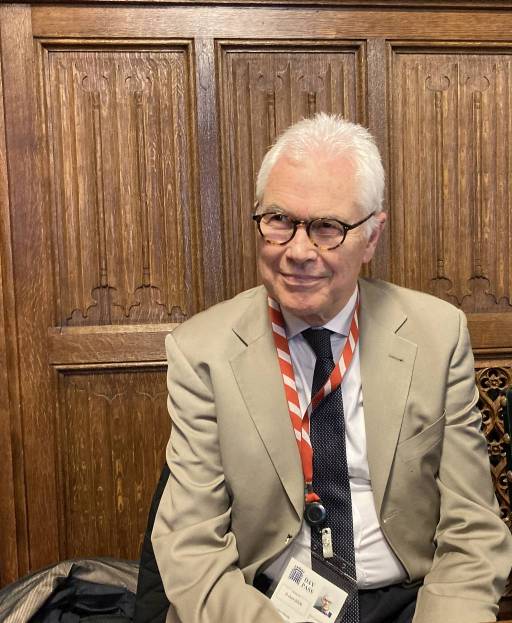
John Hendy, Baron Hendy
John Hendy: “Can I just add to that, John, and perhaps develop a point that Laura made? The answer to this is collective bargaining, isn’t it? It’s got to be collective bargaining because, particularly for freelances, if the terms and conditions are set by the employer unilaterally, then you’ve got no option. You either consent to having your product stolen or you get no work. It’s as simple as that.
“So the role of the union is absolutely crucial in negotiating collectively to lay down what John calls the ground rules, the essential protection of freelance in partly collective agreement. And, as John said, hopefully if we do get an Employment Rights Bill Mark 2, we will go back to the argument that he and I have been putting forward for decades now: that we must have more sectoral collective bargaining and that means the media sector and the creative sector as well.”
Pennie Quinton: “I was wondering whether the panel would like to respond with their expertise to this idea of the Employment Rights Bill, what they think needs to be in it? And perhaps on how we can challenge big tech, because there have been so many legal battles at the European Commission to protect work. And what we’re seeing there is real pushback from the likes of Alphabet, from the likes of Meta. So how do we take this on? It feels that states are smaller somehow than these big tech companies. Is that true? I’d love to hear from the panel on that.”
Isabelle Doran: “I definitely think that you’re absolutely right in terms of small state and big tech. I mean, their lobbying power is second to none. When you consider the amount of money that they have, which this is where the value transfer that I was mentioning before that is happening for the creative industries is going to big tech.
“And of course, this is why they’re trying to push their product and push their services to us. Obviously, for them it’s all about deregulation, it’s all about having that power and control and dictating to the rest of us how we should live our lives.
“It’s quite extraordinary when you’re not just looking at the impact on creators, but you’re looking at how they are manoeuvring forwards. And of course they have quite cleverly, obviously, selected certain politicians to help, former politicians to help them do that.
“In terms of the employment bill and in terms of collective bargaining, from an employment bill perspective, we need to remember freelances, because freelances are always left out of these sorts of things and it is very, very difficult, because within the creative industries there are so many different iterations of how freelances work.
“I think this is what we over the last few years, working as part of the Creators’ Rights Alliance coalition, were realising – just how diverse the creative industries are. Sometimes we’re lumped into one, predominantly through film and TV’s eyes, or music’s eyes; but collective bargaining doesn’t necessarily work across the board.
“Certainly, if you were looking at photographers or illustrators, if collectively we say we’re not going to work, there’ll be a whole bunch of other individual freelance photographers and illustrators that would just step into our shoes and say, ʻwell, I need the money’. The challenge we have is that at the moment we’ve got a polycrisis. We had Brexit. which restricted what people could do within Europe.
“Then we had Covid, which impacted everybody’s finances. So particularly for photographers, who often go into a studio to shoot, that work stopped – and they relied heavily on their archives to be able to get any money whatsoever.
“After that we’ve seen the cost-of-living crisis – whoever’s commissioning you, their budgets are tightening.
“Now we’ve had generative AI on top of that and of course, the political, global challenge that we’ve had with what’s happening in the Middle East… we really do need decisive action.
“There is a positive element. in that the creative industries are significant economically’ that it has a huge amount of growth potential, but it needs government to recognise that potential and protect it… Within our sector it’s $124 billion and 2.4 million people, that’s a huge amount of people. But it can’t just be one sector that’s protected and considered. Film and TV are embracing AI as of course, we’ve discovered with Equity in South Africa.
“Essentially, we need the government to recognise all creatives within the creative economy. And not all of us are financially driven. We do it for the love of it, but we still need to earn our livelihood.”
Laura Davison: “I think John has summarised the principles in terms of consent, control and compensation. And on the points that John has made about collective bargaining and sectoral collective bargaining: how do we strengthen the ability of trade unions on these fundamental issues? That is going to be absolutely key in any second Act. And the principle of transparency is also very important in that context.
“On the windfall tax and the tech companies, I think there’s growing engagement on this. We took a motion to the recent International Federation of Journalists Congress, which was appointed on the floor of the conference.
“We’ve got quite a lot of interest in what we were putting forward, and I think it was quite pioneering. We’ve had contact from other unions on that subsequently, and we’re looking now to see if we can try and build that into the TUC’s work as well in the TUC Congress in the autumn. So, I think if we can build on that, that’s probably quite a strong point that we could be doing collectively.”
John McDonnell: “We did some number crunching. I was proposing to give everyone free broadband. Do you remember? I thought it was quite a good idea at the time, and we did some number crunching around that as well. But on your point about freelances, on the point John [Hendy] will tell you that where we felt let down by the government was around definition of ʻworker’. We never got that legal definition into the legislation, so that’s one of the things we’re going to come back to.”
Kate Devlin: “So regulation’s not coming any time soon. It never does come in time. Even the EU has paused parts of the EU AI Act, and the US has dialled back on regulation, [leaving] tech companies marking their own homework. We never did get our AI bill here.
“There is talk of ʻsovereign AI’, lots of talk of that. How much of this can we bring in-house? When you look at it, not very much. You can maybe [build a] data centre so it will just deal with the UK stuff. So, we’re still so beholden to the tech companies: it feels very powerless at times.
“However, there are ways of working with this. One is the class actions that we see against the companies. In the US we have had a number of lawsuits against AI companies, particularly where people have been harmed or who have died as a result of using this software. I think also that we underestimate consumer power. Brand-shaming goes a long way, and when companies feel they are being hit where it hurts they do change things.
“We’ve seen it as well in worker protests in the US, with Google staff walking out for example a few years ago over Project Maven – where they didn’t want the defence contract renewed. The walkout helped: they did not renew the contract. I think they’ve dialled back on that now.
“I think the UK is also in a really good position because we have this incredible cultural power, this incredible soft power that we should be capitalising on. We are known for producing incredible things from the creative industries and we should be pointing out that we are at risk of losing this if we don’t sort it out. If we can’t go down the regulation route and we can’t stand up directly to these companies then it’s going to be around brand, whether it’s attacking their brand or promoting our brand.”
John McDonnell: “One example at the moment that is relevant is Palantir. MPs are getting e-mail after e-mail from constituents about Palantir, and that really has hit the fan. It’s quite remarkable.”
Kate Devlin: “And it’s a company that names itself after a piece of technology that’s known to be evil.”
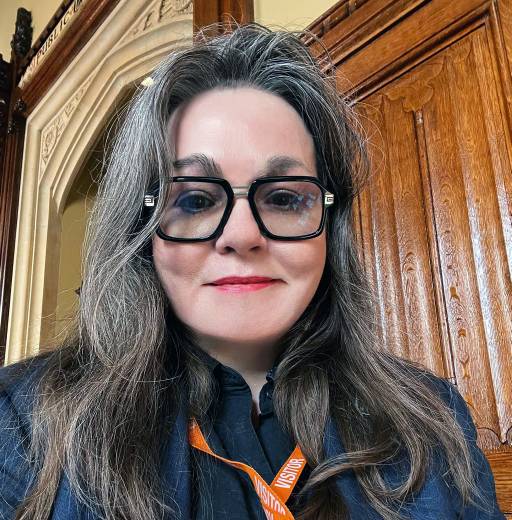
Branch Chair Pennie Quinton before the meeting
Pennie Quinton: “Obviously, we have to look at the way AI has impacted journalists in Lebanon and journalists in Gaza.
“We need to look at the many functions of AI, whether that’s weaponry, whether that’s to steal our work. We need an almost philosophical revolution that challenges the basis on which AI is functioning.
“So as a trade union, as professional organisations, we can begin to challenge it. But I think we need to be working with faith leaders, and with academics. We need everyone’s brains to come together to feed into this, because it’s huge, it’s changing the way we are and the way we understand ourselves and it’s changing us incrementally, so it’s changing the way we work, it’s changing the way we live, it’s changing the way we read.
“If you think about it - who has opened up a document and seen it ask ʻwould you like me to summarise this document - it’s a very long document’? So, if people are at work and they’re under pressure, they are reading summaries of data. So, what does that mean for our data analysis – and what does that mean for truth as well? And so, I think it’s about more than employment. There’s a much deeper level about what it means for us to be human and who we are if we’re outsourcing our thoughts.”
John Hendy: “Can I just add one thought to what the panel has just said? Clearly what’s required is a multifaceted strategy: people, power, PR, litigation in certain circumstances, legislation, of course, if we can do it. But I don’t think we’ve already accepted an industrial strategy of collective bargaining. I don’t think we should say, ʻwell, there is this category of workers, photographers, who we can’t get a collective agreement for.’ Because you’ve only got to look round the NUJ, there are sections of freelances who have been covered by a collective agreement, and in other industries, in film and television, Equity’s actors, are all freelance creatives, and they have been covered by a collective agreement. So we need an industrial strategy as well to get the union to be able to protect photographers and all other categories of freelance work.”
Isabelle Doran: “Certainly, I think there should be AI literacy. Going through this journey with generative AI emphased the fact that AI has been used as such a broad term. It applies to so many different things and AI has been around for decades.
“From a small perspective: Photoshop has had AI as a process. Generative AI is the new kid on the block, and the new bad kid on the block , and it’s there that we have a key issue.
“We also need to explain to people that generative AI is machine pattern predicting. What that means is that it’s taking everybody’s work. And this is why its output tends to be more Western in some spaces, because the West produces the most information. What it’s doing is statistical pattern predicting, which is why it comes up with such apparently human attributes, because it’s learned extremely well about our works.
“And so therefore, in terms of everybody understanding what these programs do… I think if I learn and understand something, then I’m better informed and I can make that informed decision about whether to use something or not. There’s a phrase now that I think an author recently said: ʻfriction maxing’.That is, doing something because it takes effort rather than ʻactually, oh, that will save me time…’
“I think about the pushback to smoking, from when it was first introduced and it was ʻhealthy for everybody’, and then of course over the years people realised just how bad it was for everybody’s health. I think of this in the same way, but it’s accelerated. It’s happened in a few years rather than decades.”
Laura Davison: “I absolutely agree about valuing our own brains and creativity and our potential and the humanness of the works that we produce. And I think if you’re working for an employer who seeks to devalue you and introduce these technologies, always making wholesale redundancies, then that’s a very challenging environment, isn’t it?
“But it’s even more important then, that we come together as union members to talk about that and to find strategies to deal with it. So, I think if you’re in a workplace or if you’re in a branch, just as we’ve organised this meeting so well this evening, it’s having the opportunity to actually come together and discuss it and talk about the impact on what’s happening in your workplace and how it’s making people feel and what your day-to-day working life is like in relation to AI.
“Sharing that information is a good starting point in terms of understanding each other’s experiences. And I agree about AI literacy; and training is an important part of skilling people to understand these tools. Also, if an employer is seeking to roll something out, or you’re coming across these tools in your working life, actually having that knowledge and understanding is really important, isn’t it, in how you engage and what choices you make about engaging with them. I think understanding in general how these tools operate – there isn’t the transparency there at the moment that we need, but we know that they enshrine inequalities and they reproduce biased materials. That’s also a very important aspect that we need to keep in mind when we’re talking about all of these things.”
Kate Devlin: “I agree with Isabel about literacy, and I think even extending that, not just to deal with the need to understand how the models work, but how they operate within a wider ecosystem.
“Things like the environmental threat that they pose, the energy that’s used in data centres, the amount of water, fresh water, that is used to cool these centres. And as well as that, the amount of hidden labour in the supply chain from start to finish. There are people being exploited the whole way along.
“If you start looking at all of these things, the content moderators, the people who are data labelling, the people who are impacted by the data centres, all of that, it’s a bit like fast fashion – where you say, do I really want to wear this piece of clothing that is made from terrible polyester and has been stitched together by children who are going half blind from sewing close up?
"These kind of choices that you make are ethical choices. And I think it’s a very similar thing with AI. You decide where you draw the line. So: just informing people that there is AI which can be used to good purpose in different ways. The generative AI is the one we’re seeing right now when everyone tries to build these huge models. You could do that smaller. You can have smaller language models. You can have narrower AI that serves specific domains. It doesn’t have to be the way it’s being set up right now. So, it’s about looking at that from a really critical perspective and asking, is this what you really need?”
Isabelle Doran: “You’ll be pleased to hear what I found today as I came in on the tube. I was coming in from the far end of the Metropolitan line, and somebody had stuck a sticker on an ad. It’s the first one I’ve seen, and I had to take a picture... the people sitting opposite me were rather nervous, so I was trying purposely to turn the camera upwards rather than at them. But it said ʻresist AI’ and it said that three years ago you didn’t need these programs. Why do you need them now?
“AI may be able to trawl through lots of information and extract things; that is very different from generative AI. And it’s generative AI that is misinformation and disinformation. And that is the challenge that we face, because there is no labelling of that synthetic AI output.
“We’re finding that politicians, for example, can be mimicked by AI, saying something or doing something that they’ve never done.
“If you’re using it to process information and it’s generally trying to find the information you’re after, that’s fine. If it’s generative, that is the problem. If you look at our politics at the moment, it’s so divisive because of what’s happening on social media and there’s so much on there. Can you really believe it?
“Obviously, that’s where the importance of journalism comes in, because that’s where the trusted source is. What we’ve all learned and appreciated over decades is the importance of trusted sources and trusted journalism.”
Kate Devlin: “One of the really positive things coming out of that for trusted sources and particularly in freelancing is the ability to now go directly to people via different types of work like Substack, like Medium, like all of those things where you can build up a reputation for doing that kind of work. And I think that’s one of the strengths of being freelance at the moment: you’re not tied to a company, a publisher who has sold their rights to some kind of AI company and instead you’re able to produce that kind of content. However, I’m very painfully aware that is not produced for free.”
Isabelle Doran: “Also, it can be scraped.”
Kate Devlin: “And it can be scraped, yes.”
Pennie Quinton: “There was a story in the Guardian today which was talking about ʻnews deserts’. Where there are local reporting deserts, that is where misinformation can easily take hold; and there’s more manipulation of elections. We’ve seen the demise of local journalism because of the demise of advertising through the use of search engines. But what that is also feeding into is misinformation, because very many people have trouble discerning truth from fiction. So it comes back to the panel’s point about literacy and people being able to discern what is in front of them.”
Laura Davison: “It’s also about supporting a wider ecosystem of local journalism, investigative journalism, as you say, and there are lots of opportunities around that at the moment. The government has produced a local media strategy which has got some things in it which could be useful, including a Local News Fund – about which you’ll get more details in due course. Organisations will be able to apply for funding to support local news projects – so we are looking at news deserts. I think it could go further and it could go on for longer and have more money in it; but it is something
“And we’re in the middle of the process of the BBC charter renewal. Getting that right and making sure that the BBC has proper, suitable, sufficient funding and that there’s investment in all of that work that the BBC could be doing, that the government has said it might want the BBC to take on, including in terms of AI and media literacy.
“Obviously there needs to be proper funding for those things. The BBC is a big economic driver in the creative sector, so it is also really important to get that right.”
John McDonnell: “I’ve got to go and vote in favour of nationalising the steel industry.
“On Laura’s proposals with regards to the tech levy... That resource could absolutely reinvigorate local journalism, couldn’t it, in terms of investment on a scale that we’ve not seen before? Before I go, I think there will be a number of votes, so I might not be able to get back. You asked us what we can do?
“We can work together with other unions, with John on employment rights, to get inclusion of these basic principles in this legislation.
“I know legislation can’t resolve everything, but what it can do is provide the foundations for negotiations, especially if we can get sectoral collective bargaining and a proper legal definition of ʻworker’.
“But the most important thing, I think, for us to do is just get this raised at every opportunity we can, to have the discussion that I think it is emerging. I was at the Robert Tressell festival in Dublin at the weekend and Roddy Doyle was there and they asked him the question, ‘do you think AI could reproduce one of your novels?’
“He said, ‘I’ve looked at this. You cannot beat human engagement in literature or in writing and journalism overall’.
“We’ve got to get that across to people and the thing that I and others said, which I thought was really useful, is we’ve got to stop people thinking this is inevitable and uncontrollable.”
Kate Devlin: “Absolutely.”
John McDonnell: “As Mark Fisher titled a chapter in Capitalist Realism, it’s easier to envisage the end of the world than the end of capitalism. It’s as though at the moment they can just walk over us. We can defend ourselves, but also, we can harness it to our advantage, that’s the thing.
John McDonnell left committee room 12 upbeat, asking “Whoever thought we’d be nationalising the steel industry?”
Giovanni Ulleri: “I’m a freelance documentary maker. Do you think that in terms of legislation that the examples of cigarettes or the food industry could be helpful?
“As journalists, one of the things we are trained in is ethics. One thing that concerns me is that in my field, there are deep fakes out there, videos which are complete fabrications, and people are believing in this nonsense. There should be legislation to ensure that we know what trusted brands are. There should be a logo or something that we can put on.
“For example, when I make a documentary in current affairs, if I do a reconstruction, I have to put ʻreconstruction’ on the screen, because otherwise the viewer will think that’s action material that’s used, but it’s not, I’ve reconstructed it. That’s an Ofcom thing, it’s not necessarily legislation, it’s an agreement, but I do think in terms of the way social media is going, that we should be introducing in legislation a requirement for all of the companies that, if it’s been deep-faked, they should put that on the damn thing, so people out there in the audience know. Do you think that’s being done?”
Kate Devlin: “This is something that the Society of Authors are trying to introduce with a ʻhuman-authored’ stamp on books to say that AI hasn’t been used in the production process or in the writing process. The first one came out last year: Sarah Hall’s novel Helm had a human-written stamp on the cover. That only worked because it was backed by Faber and Faber, which is a very trusted source. Anyone could just slap a ʻhuman-written’ sign on anything.
“So, yes, I agree about the importance of trusted brands. Maybe if the BBC says, yes, we are doing this – ʻno, there’s no AI in this’...”
Isabelle Doran: “I think that for certain types of works, where you’ve got fewer works, as with books, it’s easier to label. We still support human-made labelling, where you have the opportunity. But for, for example: if they’re in a war zone shooting photographic work, they’ll produce hundreds, if not thousands of images. Traditionally the press would take those images. So, human labelling in some respects is still a burden on us.
“What I definitely strongly believe is that there should be legislation that impresses upon the AI developers who are providing these services that synthetic AI output should be labelled. Absolutely. But as I mentioned earlier, that might affect every single part of a film, but it certainly could be done on single items.
“It’s simply that big tech do not want regulation, they do not want labelling, they just want to avoid any responsibility.
“As you were mentioning, with the food industry, you have standards and traceability: you know the origin of what you’re eating. It’s important that when you go into a supermarket, you pick up a product, and you can see the ingredients and you can trust that the source is where it’s from.
“If we can do it for such a complex system and globally, we can definitely do it for generative AI. So it’s just about the willingness, and this is why it’s so important that not only us as individuals, but us as unions, as trade associations, et cetera, need to keep pestering our MPs and pestering government to do something about it.”
Laura Davison: “It’s also working with other partners around the world, isn’t it?
“So, while the trade unions are looking at these issues in different countries, where they come together under the International Federation of Journalists, that’s very powerful to share those examples. I think that as well as doing the work that we’re doing here, we have to think about how we engage worldwide on these things.
“Coming back on the safety point… the abuse, the kind of turbo-charging of abuse against people, is a really important issue to raise. I think the AI aspect of all of that work that the union and others have been doing collectively on the safety of people to be able to carry out their profession is something that we need to continue and to push very strongly.
“I want to flag the NUJ Safety Tracker in that context as well, which is a tool that’s been developed where people can report incidents that happen. Building up that collection of data is very important for the work that we’re doing to try to work with the government and develop other ways that we can protect journalists in doing their day-to-day work.”
Pennie Quinton: “Can I ask people in the room, if out of today people wanted to work on a manifesto? Who would be interested in being involved? Can we get a hand count of who would be interested in working on something?
“I was thinking about what we’re experiencing at a grassroots level and what we’re experiencing in our work. So how can we share and bring stuff together? I think it’s moving so fast that we need to hear how people are being paid, how people are affected. So, anyone that would like to be involved in this, come and give me your e-mail at the end and we will figure something out.
Isabelle Doran: “I think the challenge we’ve seen is because we first saw generative AI in 2022, and we’re now in 2026 and it’s extremely hard to get MPs involved. Because there are so many issues that the constituents will also be giving them. We have a cost of living crisis and we have people in different parts of the country who are really suffering financially. It does make it very difficult for MPs who have got a long list of different priorities.
“We have to keep putting the pressure on. We were very fortunate with the Data Use and Access Bill that we had fantastic support from members of House of Lords. I’m trying to recall now how many times the Bill went back and forth, in ʻping pong’, something like six times.
“It was extraordinary, the passion that was felt by the Lords. Many of them are copyright holders. So we know we have their support in that space and MPs obviously will, you know, support as and when.
“At the moment,though, the Labour Party has a majority of 400 seats and many of them have to still follow what, you know, their party leader and the government want. I think a challenge is that we have certain persuasive former politicians saying that ʻwe need to adopt AI’. We won’t share names, but it’s very, very difficult because the lure of AI and the promise of investment is so big. It’s very hard to cut through.
“We can’t do this alone. There are some policy working groups coming down the track as a result of the 18 March 2026 report; with invited organisations looking at personality rights; at labelling AI-generated content; at creator control and transparency; and at other ways to support creators.
“It still feels like they’re pushing the can down the road. But it means that when you’re writing to your MP, they will be responding. The point that Pennie was making is important: we need to be reporting what is happening on the ground.
“When we sent out our survey in January we only ran it for a few weeks, but I asked for anecdotal responses. We got tens of pages of responses. It was really invaluable to see that information, so we know what’s happening and we can share that information. So not just collective bargaining but collectively we need to push government.”
Laura Davison: “I would just like to speak up for our NUJ parliamentary group and all the work that they do in pushing the issues that we have collectively. They work extremely hard to get those issues onto the agenda, speaking in debates and raising questions. This is certainly an area where they have worked hard – and I think progress was made because when the AI and copyright consultation came out initially, it was very clear what the government’s preferred direction of travel was.
“But actually, all the work that was done, the campaigning work, the question asking, all the lobbying, it worked and it pushed the government back. So, you know, we achieved that, so that’s a positive.
“Obviously, we need to go much further and there’s a lot more work to be done. But that was a process which got some attention, and there are other stages of that to follow, so we obviously need to make the most of those.
“I think there are lots of tools that we can use to get that first-hand experience from people in the workplace. Survey tools are very important. We have a session tomorrow that’s being run. with some of our networks. We have an equalities network and a health and safety network. They’ve organised a session looking at these issues, to hear from people directly their experiences in the workplace on AI specifically.
“So there’s all of that information that we’re gathering and the committee that we’re launching later this week. I want to be very practical in terms of how we can take these issues forward, to look at issues around collective bargaining. How do you resist some of these things? What are the things that members can do in their workplaces and more widely on these issues?
“I think it is so big that it can be quite difficult for people to get a full handle on it. But I think the more familiar people become with these issues, the more that they talk about them, the more that we can identify specific things that people can push back on, the stronger we’ll be collectively.
“And, on those acts of resistance, we did have an industrial action ballot at the newspaper group Reach plc last year, which was particularly supported by our members at the Mirror who were very concerned about the rollout of AI within that organisation. So, we have started to see some examples of collective balancing, looking at some of these points.”
Pennie Quinton: “The TUC reports talk a lot about privacy in the workplace and AI; I wonder, from a journalist perspective, how can we protect our sources? I think that’s a really big question because sources come to us with material and in the age of AI how can we protect the identity of people sharing with journalists information that is highly confidential and highly dangerous to themselves?”
Kate Devlin: “Don’t put it anywhere near a large language model is the main thing, basically that’s the big one.”
Isabelle Doran: “I would also suggest taking a few steps back technology-wise, I mean - use old-fashioned computer servers [that are on your premises]; keep everything offline. We’re thinking of doing that: we used to use a cloud server. As you know, everybody was pushed towards cloud software. Going back to old-fashioned servers is probably a safer way of doing things.”
Laura Davison: “I think it is about looking at these issues, in terms of people’s knowledge and understanding and making sure that people are getting training and the level of understanding of how these tools are working, and how you can protect yourself. It ties into a lot of work that’s been done on other strands like surveillance, how that is exponentially developing as well. I think it’s a very important point to raise and something that we need to continue to educate our members on.”
Pennie Quinton: “Thank you, everyone. I think we’re going to draw it to a close. I would like to give a huge round of applause for our panel and for John. Thank you, everyone.”
 'Artificial Intelligence' our coverage to date