![[Freelance]](../gif/fl3H.png)
TUC backs NUJ on tech tax and BBC
AT THE 2026 Trades Union Congress (TUC) in Brighton from 13 to 16 September the NUJ delegation consisted of Laura Davison, general secretary; Fran McNulty, joint president; Natasha Hirst, Equality Council co-chair; Pennie Quinton, London Freelance Branch chair; and Steve Bird, Newspapers and Agencies Council chair.
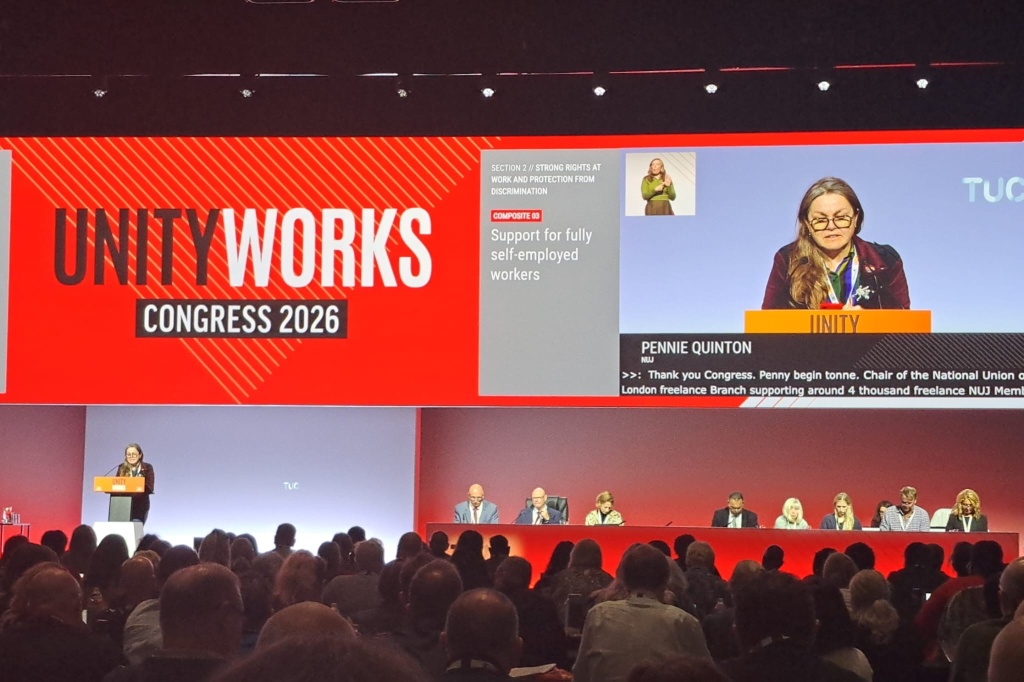
Pennie Quinton addresses Congress
Taxing the tech giants
The first of two motions submitted by the NUJ called on global tech giants to pay their fair share to protect media industries. It was composited with motions from UNISON, the National Union of Rail, Maritime and Transport Workers (RMT) and the Transport Salaried Staffs’ Association (TSSA), which similarly urged the government to redistribute wealth from corporations to workers.
Speaking in support of the motion, General Secretary Laura Davison highlighted “swingeing cuts” to the BBC and other public service broadcasters as well as “relentless job cuts” at local news, with “AI overviews” resulting in a huge loss of traffic and advertising for publishers… tech platforms have sucked up editorial content without making any contribution to its production.” While welcoming the government’s £12-million Local News Fund, she said that this alone was “not enough to fundamentally reset the sector”.
She described a windfall tech tax as a “simple and practical step to generate funding” that could be reinvested “to protect jobs, improve conditions, and increase public access to quality news, retaining editorial independence”. The motion called for a strengthened digital services tax to sustain funding for ethical and strong public service journalism and was carried unanimously.
Extending rights for freelances
Pennie Quinton spoke in support of Equity and Prospect’s motion, “Support for fully self-employed workers”. She highlighted the government’s consultation on whether freelance and self-employed workers should submit tax returns on a monthly rather than a yearly basis.
Any changes to income tax self-assessment “must be designed with an understanding of how journalists and other creative workers are paid and engaged” due to the unpredictable nature of freelance work and the significant delays members often experience in receiving payment.
Pennie told Congress: “Tax systems designed around stable and predictable employment patterns risk creating unintended consequences for the large numbers of workers whose careers depend upon irregular, freelance work.
“Our members have expressed concerns at what this might mean in terms of their having taking time to administer tax each month during periods of intense deadline-focused work, such as reporting in conflict zones or working on travel-based assignments.” The motion called on the TUC to campaign for reforms to employment rights and income security for self-employed workers and to lobby the government to address issues facing freelances – including unfair taxation, the gender pay gap, and lack of trade union protections. The motion carried unanimously.
Women’s safety & the far right
At TUC Women’s Conference in March the NUJ co-sponsored a motion on the rise of the far right and the weaponisation of women’s and girls’ safety in political discourse. This motion was selected by vote to be moved at TUC Congress.
Natasha Hirst, NUJ Equality Council co-chair, stressed the importance of journalist scrutiny of far-right organisations’ narratives. She said, “Our members play a vital role in challenging the ideologies and actions of those who use oppression and discrimination as a tool to roll back the rights that we’ve all spent so long fighting for… This often means that journalists are targeted by the far right – both on social media and while covering public events… Supporting our members to do their jobs well and protecting their safety at work is core to the NUJ’s mission. We also campaign for the press regulators to take stronger action to prevent discriminatory reporting.” It was passed unanimously.
Supporting disabled workers
Hirst also spoke in support of a motion from the TUC Disabled Workers’ Conference on the government’s plans to “support people into work” by implementing damaging welfare reforms. “This is a frightening time for disabled people in the UK. We are trying to survive in a society that does not value our lives,”
Protecting public service broadcasters
Fran McNulty, NUJ joint president, moved a motion expressing support for workers at the BBC and other public service broadcasters. Fran underlined the pressures facing members in the broadcasting sector due to constant cuts. The BBC recently announced plans to cut 2000 jobs… McNulty noted that the world would be “much darker” without the BBC. Social media companies operate in “a wild west with little regulation” and “zero editorial scrutiny”, serving shareholders, not the people. This means that a tech billionaire can buy a platform like Twitter and turn it into “a cesspit of hate, racism, abuse and misinformation.”